NIH Guidelines Update for Research Involving Recombinant and Synthetic Nucleic Acids
The NIH has updated guidelines for research involving recombinant and synthetic nucleic acid molecules. This document outlines critical changes, such as new exemptions for synthetic nucleic acids and the implications for chemical synthesis and gene cloning, particularly using non-hazardous plasmids with non-pathogenic E. coli. It emphasizes revisions applicable as of March 3, 2013, including requirements for risk assessment and the reduced review for certain AAV serotypes. Understanding these guidelines is crucial for researchers in molecular biology and genetic engineering.

NIH Guidelines Update for Research Involving Recombinant and Synthetic Nucleic Acids
E N D
Presentation Transcript
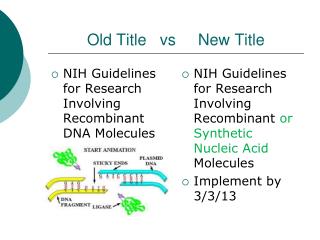
Old Title vs New Title • NIH Guidelines for Research Involving Recombinant DNA Molecules • NIH Guidelines for Research Involving Recombinant or Synthetic Nucleic Acid Molecules • Implement by 3/3/13
Is chemical synthesis covered? synthesizer Not until in a …
III-F Registrations • Nothing exempt in Boston • BPHC adopts updated Guidelines unless… • Using nonhazardous plasmids (pBR) to clone gene of interest into host (nonpathogenic E.coli) • Often the first step in creating a transgenic animal • New exemptions for synthetic NA • No origin of replication, no integration…
NIH Guidelines: Definition of rNA • Molecules constructed by joining nucleic acids • & can replicate in a living cell
NIH Guidelines: synthetic • Nucleic acids that can base pr w naturally occurring nucleic acids
NIH Definitions Continued • Molecules resulting from replication of rNA or synthetic nucleic acids in past two slides
Other Changes • Fewer AAV serotypes need review • Transfer of drug resistance traits • Human Gene Transfer w nucleic acids
Risk Assessment & Synthetics • % of genome from each parent • Fn/purpose of each sequence • Assume same fn as original host? • Synergism between sequences & transgenes
What Next? - XNA • ~6 sugars can form NA bbone • Store & retrieve genetic info • Medical benefit? Slower breakdown in stomach & bloodstream
Real World Examples • iGEM 2006 • Jay Keasling