Understanding Abstract Data Types: Lists, Stacks, and Queues in C++
This chapter explores the fundamental concepts of Abstract Data Types (ADTs) such as lists, stacks, queues, and other structures. It covers key operations associated with these data types, illustrating implementation examples like the Vector ADT in C++'s Standard Template Library (STL). The chapter highlights the role of iterators in navigating data structures, demonstrating both their utility and methods. Additionally, it provides insights into customizing ADTs and the importance of encapsulating data with associated operations, making it easier for developers to manipulate collections effectively.

Understanding Abstract Data Types: Lists, Stacks, and Queues in C++
E N D
Presentation Transcript
Chapter 3 Lists, Stacks, and QueuesAbstract Data Types, Vectors • Sections 3.1, 3.2, 3.3, 3.4 • Abstract Data Types (ADT) • Iterators • Implementation of Vector
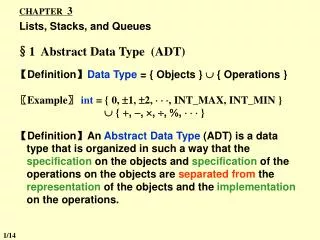
Abstract Data Type (ADT) • High-level definition of data types • An ADT specifies • A collection of data • A set of operations on the data or subsets of the data • ADT does not specify how the operations should be implemented • Examples • list, stack, queue, deque, priority queue, table (map), associative array, set, graph, digraph • How are they different? • Class • Class template • ADT
List ADT • Objects/data • A0, A1, A2, … A N-1 • Size of the List is N • Operations • Up to the designer of a List, for example, • printList() • makeEmpty() • Find() • Insert() • Remove() • findKth() • etc
Iterators: Motivation • Need a way to navigate through the items in a container. • An example: navigating over vector v. for (int i = 0; i != v.size(); i++ ) cout << v[i] << endl; • However, doubly-linked list would need a different form • We want a general approach to navigate elements for different implementations of an ADT
Iterators • A generalized type that helps in navigating a container • A way to initialize at the front and back of a list • A way to move to the next or previous position • A way to detect the end of an iteration • A way to retrieve the current value • Implemented as nested types of containers in STL • Examples: • Iterator type for vector<int> defined as • vector<int>::iterator itr; • Iterator type for list<string> defined as • list<string>::iterator itr;
Getting an Iterator • Two methods in all STL containers • iterator begin ( ) • Returns an iterator to the first item in the container • iterator end ( ) • Returns an iterator representing end marker in the container (that is, the position after the last item) • Example for (int i = 0; i != v.size(); i++ ) cout << v[i] << endl; can be written using iterators as for(vector<int>::iterator itr=v.begin(); itr!=v.end(); itr++) cout << itr++ << endl;
Iterator Methods • Iterators have methods • Many methods use operator overloading • itr++ and ++itradvance the iterator to next location • *itr return reference to object stored at iterator itr’s location • itr1 == itr2true if itr1 and itr2 refer to the same location, else false • itr1 != itr2true if itr1 and itr2 refer to different locations, else false
Container Operations Requiring Iterators • Adding element • iterator insert(iterator pos, const object &x) • Add x in list before interator pos • Returns iterator representing position of inserted item • Removing element • iterator erase(iterator pos) • Remove element at position pos • Returns iterator representing position of item following pos • Removing elements in a range • iterator erase(iterator start, iterator end) • Remove elements from start to end (not including end)
Iterator example • Removing every other elements in a list
The Vector Implementation of List ADT • Extends the notion of array by storing a sequence of arbitrary objects • Informally, we call it Vector ADT • Elements of vector ADT can be accessed by specifying their index
vector in C++ STL • Collection Elements of some proper type T • Operations • int size ( ) returns the number of elements in the vector • void clear ( ) removes all elements from the vector • bool empty ( ) returns true if the vector has no elements • void push_back ( const Object &x ) • adds x to the end of the vector • void pop_back ( ) • Removes the object at the end of the vector • Object & back ( ) • Returns the object at the end of the vector • Object & front ( ) • Returns the object at the front of the vector
vector in C++ STL (contd.) • More Operations • Object & operator[] ( int index ) • Returns the object at location index (without bounds checking) • Both accessor and mutator versions • int capacity ( ) • Returns the internal capacity of the vector • Number of elements the container can holdwithout further memory allocation • void resize( int newSize, const Object& val = Object() ) • Change the size of the vector • Newly created elements will be initialized to val
Implementing the vector Class • Implementing Vector as first-class type • Can be copied • Memory it uses is automatically reclaimed • Vector maintains • A primitive C++ array • The array capacity • The current number of items stored in the vector • Operations • Copy constructor • operator= • Destructor to reclaim primitive array • All the other operators we saw earlier
vector Implementation template <typename T> class vector { public: // lots of member functions typedef T * iterator; private: int theSize; int theCapacity T *Array };
vector Member Functions - 1 vector(int initialSize=1) : theSize(initialSize),theCapacity(initialSize+1) {Array = new T[theCapacity];} ~vector() {delete [] Array;} void pop_back() {theSize--;} O(1) iterator begin() {return Array;} iterator end() {return Array + theSize;} T &operator[](int index) {return Array[index];} O(1)
vector Member Functions - 2 vector &operator=(vector &rhs) { if(this != &rhs) // Prevents self-copy { delete Array; theSize = rhs.size(); theCapacity = rhs.theCapacity; Array = new T[ capacity() ]; for(int k=0; k<size(); k++) Array[k] = rhs.Array[k]; } } 16
vector Member Functions - 3 void reserve(int N) { if(N < theSize) return; T *old = Array; Array = new T[N]; for(int k=0;k<theSize;k++) Array[k] = old[k]; theCapacity = N; delete [] old; } O(N) Array old void push_back(T &x) { if(theSize==theCapacity) reserve(2*theSize); // Assumes theSize > 0 Array[theSize++] = x; } 17
Amortized Analysis of push_back • Consider the time for N push_backs • Time for copying the data = N*O(1) = O(N) • Let 2k <= N < 2k+1 • Time for call to reserve = O(1 + 2 + 4 + ... + 2k+1) = O(2k+2-1) = O(2N) = O(N) • So, the total amortized time per push_back is O(1) 18