Learning Theories
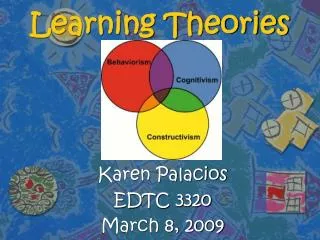
Explore the foundational learning theories: Behaviorism focuses on observable behavior and reinforcement to shape learning outcomes. Cognitivism examines internal mental processes akin to computer information processing, emphasizing memory's role in learning. Constructivism asserts that knowledge is actively constructed through personal experiences, advocating for meaningful, engaging activities in education. This comprehensive overview contrasts these paradigms and highlights their implications for teaching methodologies.

Learning Theories
E N D
Presentation Transcript
Learning Theories Behaviorism, Cognitivism & Constructivism
Behaviorism • The focus is on cause and effect relationships. • Why? Because they can be observed through behavior. • Internal process are not visible • Behavior can be modified through contingencies of reinforcement For more information on Behaviorism visit: http://web.cocc.edu/cbuell/theories/behaviorism.htm
Contingencies of Reinforcement • A learner can be conditioned to exert the desired response. • Three situations shaping behavior: • Positive reinforcement (i.e. reward) • Negative reinforcement (i.e. leaving early to avoid traffic) • Punishment (i.e. a failing grade for cheating)
Cognitivism (a.k.a. Information Processing) • The focus is on internal processes, instead of strictly external events. • Uses the analogy of a computer to illustrate how the mind processes information. • This theory proposes that the mind has 3 different memory stores that work in succession to register, process, store, and retrieve information. For more information on Cognitivism visit: http://web.cocc.edu/cbuell/theories/cognitivism.htm
Constructivism • This philosophy says that humans construct all knowledge in their minds by participating in experiences. • Learning occurs when a person constructs the mechanisms for learning and their own unique version of that knowledge • Constructivists recommend that students participate in meaningful activities so that learners are able to generate their own knowledge. For more information on Constructivism visit: http://web.cocc.edu/cbuell/theories/constructivism.htm
Directed Instruction Constructivst Instruction vs.
Learning Theory Assignment The design I used for my PowerPoint is fairly simple because adding too much color or “pizzazz” to the background makes the information difficult to read. I used a design that resembled a piece of lined paper for slides 2-5 so that the text stood out. I used a text and table layout for slide 6 to contrast the differences between directed and constructivist instruction. I inserted hyperlinks at the bottom of 3 slides; slide 2 (behaviorism), slide 4 (cognitivism), and slide 5 (constructivism) because the hyperlinks directly relate to the material in each of the slides. The hyperlinks I choose are easy to understand, and not too wordy or confusing. I did not include all the information presented to us in class because if I included all information, there would be no need for anybody to listen to the lecture presented with the PowerPoint. For example, in slide 3 I listed the contingencies for reinforcement and gave examples, but did not define what “positive reinforcement” or “negative reinforcement” means. I think it is important to understand that the PowerPoint is not supposed to take place of the lecture/presentation, but is meant to supplement the lecture.
Hi Dennis- I was unable to add any sound effects to my PowerPoint because I have to install the sound effects from the CD-ROM and I do not have the CD anymore! I know how to do it and will add a sound effect in class on Thursday if you wish. Sorry! Hope you had a great anniversary. -Kara Kantrowitz