Download
1 / 21
210 likes | 308 Vues
This program focuses on improving safety at rail-highway level crossings in Texas through dedicated fund programs, state initiatives, and comprehensive action plans. By implementing measures such as grade separation projects, signal maintenance, and replanking programs, Texas aims to reduce auto-train collisions and fatalities, ensuring safer transportation for its residents. Through strategic collaboration with stakeholders, evaluation of collision data, and targeted education efforts, the state endeavors to enhance the overall safety and efficiency of its railway systems.

E N D
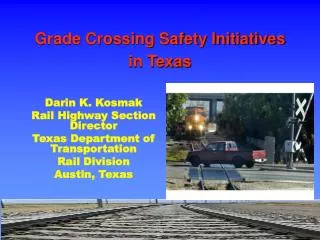
Grade Crossing Safety Initiativesin Texas Darin K. Kosmak Rail Highway Section Director Texas Department of Transportation Rail Division Austin, Texas
2010 Dedicated Fund Programs • Federal RR Signal - $15.0 M • Federal RR Grade Separation - $25.0 M • State Grade Crossing Replanking - $ 3.5 M • State RR Signal Maintenance - $ 1.1M Total dedicated fund programs = $44.6 M / YR
Program Overview • Texas has most public highway-rail grade crossings (9,784) & RXR crashes in U.S. • Auto-train collisions, injuries and fatalities have decreased by 68% over past 20 years. • Lowest reported fatalities in each of past two years (2008 – 09). • During FY 2010, Railroads installed 143 crossing signal projects at cost of $30.4M. • In FY 2010, 33 Highway-rail grade separation projects went to contract statewide.
State Replanking Program • One of only a few remaining state funded programs of work for resurfacing on-system crossings • The Commission reauthorizes and funds the program as part of the UTP. • Program only funds reimbursements to Railroads. TCP and approach work must be funded thru TxDOT district maintenance budgets. • 2010 Program funded 46 projects at a cost of $3.16 Million. • Project work is contracted directly with the operating railroad company.
Federal Railroad Administration Crossing Safety Action Plan • Federal Rail Safety Improvement Act – • Passed into Law on October 16, 2008 • FRA Final Rule issued June 28, 2010 • Requires 10 States with highest number of fatal crashes to implement crossing safety action plans. • Inventory Reporting • EN Signs/numbers • Crash reporting
Texas Crossing Safety Action PlanGoals & Objectives • Identify Crossings with Multi-Collisions • Identify and Evaluate Crossing & Crash Data at Multi-Collision crossings • Identify & Evaluate Other Statewide Crossing Safety Needs to Focus Mitigation Efforts • Develop 5-Year Safety Action Improvement & Implementation Plan
Crossing Safety Improvement Stakeholders Meeting • Developed List of Safety Action Plan Recommendations for Program Areas: • Evaluation • Engineering • Education • Enforcement
Program Area RecommendationsEvaluation • Improve Communication to Stakeholders of RXR Safety Improvement Programs & Strategies • Research & Provide Collision Data to Identify Multi-Collision Crossings • Update TxDOT Priority Index Formula
Program Area RecommendationsEngineering • Use Sec. 130 funds to require closures • Preemption Upgrades • Local participation to encourage low cost safety improvements: YIELD/STOP signs, AW signs, medians
Program Area RecommendationsEducation • Driver Education Tools & Education Materials • Operation Lifesaver – Focus Mitigation Efforts to high-incident regions • Update & Re-Publish TxDOT RXR Public Information Materials on Website & E-mail list.
2003-07 Crash Data Analysis at Multi-Collision Crossings • Total of 1,328 collisions at 1,044 crossings • Casualties: Non-injury 60%, injury-only 31%, fatal 9% • 61% of total collision-crossings had active warning devices in place • 35% of crashes occurred at active crossings where multiple-collisions were reported • 80% of the 1,328 collisions occurred at crossings located within close proximity of a nearby Highway Intersection
Collision Analysis of Crossings Located Near Highway Intersections • 229 of 803 reported RR active warning devices interconnected with nearby traffic signals • Of the 229 reports, 46% occurred at multi-collision crossings • 42% occurred at crossings located less than 75 feet from adjacent highway intersection, & • 69% of the crossings had active warning devices
Conclusions of Collision Analysis • Higher incident of collisions at crossings: 1. Located adjacent to highway intersections 2. With multi-collisions located adjacent to highway intersections 3. With railroad signals interconnected with adjacent traffic signals
Texas Crossing Safety Action Plan 5-Year Implementation Plan Education & Enforcement • Coordinate with Texas Operation Lifesaver to focus crossing safety mitigation efforts in auto-train collision high incident regions. • Print second edition of Grade Crossing Law Enforcement pocket guides. • Update & re-publish TxDOT RXR Public Information Handbook materials on TxDOT website. • Communicate events and new information to e-mail group account of crossing safety stakeholders.
Texas Crossing Safety Action Plan 5-Year Implementation Plan Evaluation & Engineering • Include “Gated” Crossings Reporting Multiple Collisions in TX PI Formula Rankings • Upgrade Preemption at Interconnected Crossings • Focus on Crossing Corridor Safety Upgrade Projects • Install more YIELD/STOP signs at Passive Crossings • Identify Passive Crossings w/ Limited Sight Distance for Signal Upgrade or Closure* • Local Cost participation for road work (medians, curbs), utilities, ROW, Quiet Zones, Traffic Signal upgrades • Railroad Cost Participation for Wayside upgrades, replanking, closing crossings, and signal/gate re-hab
Texas Crossing Safety Action Plan 5-Year Implementation Plan Evaluation & Engineering • Monitor and update annual performance workload measure: “% of signalized public railroad crossings”. • Establish new performance workload measure: “% reduction of crossings experiencing multi-collisions” • Establish new performance workload measure: “RXR Fatal & Serious Injury Crash Rate” • Conduct research to develop warrants for passive to active upgrades at low volume crossings • Upgrade railroad crossing inventory database, update priority index, and continue crash data analysis
Developing Warrants for Active Warning Devices at Low-Volume Highway-Rail Grade Crossings Project Abstract • Two-year research project. • Develop a highway-rail crossing prioritization system. • Revised safety index and warrants for active warning devices at low-volume highway-rail grade crossings. The Research Scope • Emphasizes low-volume crossings in the lower-third of the priority list generated with the current Texas Priority Index. • variables in the safety index present challenging mathematical characteristics and must be modeled using appropriate methods. • Deliverables will facilitate rail-highway crossing management in Texas, ensuring proper consideration of low-volume roads when applying Section 130 funding mechanisms
Developing Warrants for Active Warning Devices at Low-Volume Highway-Rail Grade Crossings Project Organization & Implementation • At the end of the first year: TxDOT will have a provisional set of warrants, and a list of crossings eligible for improvements with cost estimates. Evaluation of this early implementation will be used to refine the warrants during the second year. • At the end of the project, TxDOT will have revised warrants based on this practical implementation, a new list of eligible crossings based on the revised warrants, a revised safety index and protection factors, a methodology to rank crossings that meet those warrants, and a prioritized list of all crossings, prepared with the new methodology.
Texas Railroad Crossing Inventory Database Project - TRAX • The vendor has been selected and is now under contract to develop the new database • TRAX will be web-based, geospatial, data integration database for managing crossing inventory, crash records analysis, project prioritization/selection, project workflow tracking, financial processing and contract management • TRAX is a two (2) year project. District and Railroad staff will be involved in development & testing of the database • TRAX will replace TRACI (web based) & TxRAIL (internal) databases currently in use by TxDOT
Keys to Success • Timely and accurate prep of project PS&E • Dedicated Funding • Timely Reporting • Accurate Records • Good Database • Communication Coordination & Cooperation