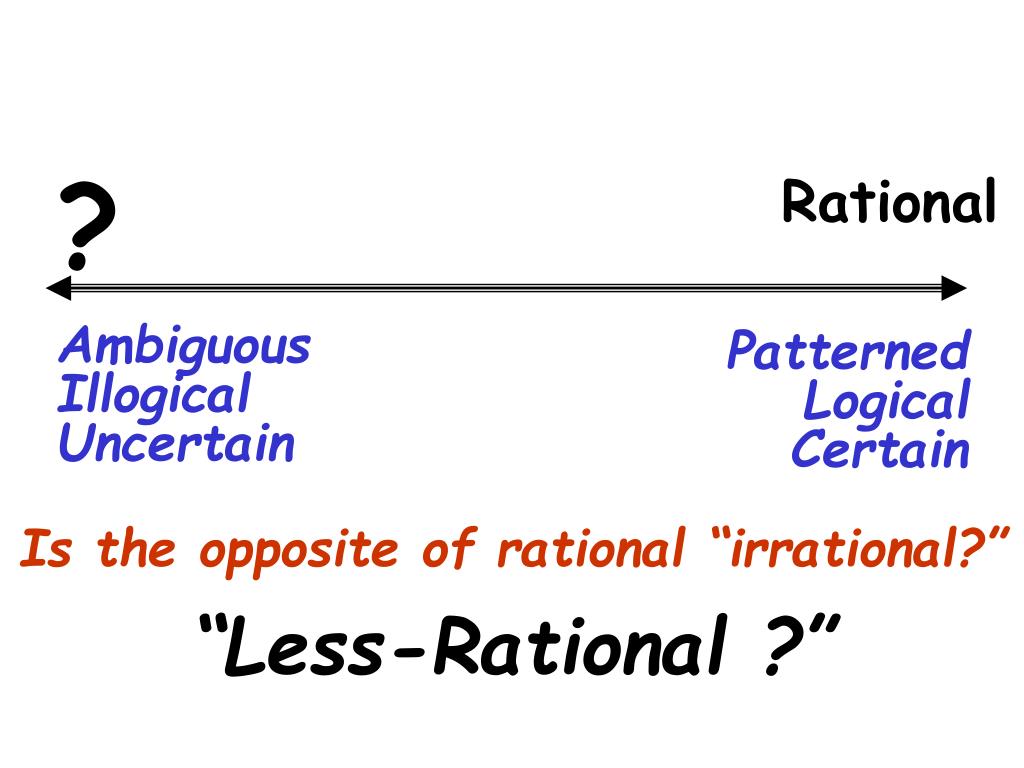
? Rational Ambiguous Illogical Uncertain Patterned Logical Certain Is the opposite of rational “irrational?” “Less-Rational ?”
Left Brain Logical Sequential Rational Analytical Objective Looks at parts Right Brain Random Intuitive Holistic Synthesizing Subjective Looks at wholes Left Brain / Right Brain http://similarminds.com/brain.html http://brain.web-us.com/brain/braindominance.htm http://www.testcafe.com/lbrb/lbrb.html
How Bounded Rationality works Problem Minimum Standards X Y Z A1 Simplified Problem A2 A3 ? A1 $x, y, z? Yes First Satisficing Choice A2 $x, y, z? No $x, y, z? A3 A4 A5
An “Open,” Behavioral Model Period #1 Period #2 Period #3
Information • Quantity • Quality • Confidence
Quantitative Analysis • The “Role” of Quantitative Analysis • “Types” of Quantitative Analysis • “Simple” evaluation matrixes • Decision trees • Probability theory • Break-even analysis • Ratio analysis (ROI, ROE, etc.) • Marginal analysis • Sensitivity analysis • Game theory • Linear programming • Queuing theory
Decision Trees
Nature & Role of “Intuition” • Related to Heuristics • Form of “Bounded Rationality” • Used more in areas of “expertise” • Identify course of action as soon as problem is recognized • Breaking down the problem into “parts” will actually spoil the process • Experience factors in the circumstances
Nature & Role of “Intuition” • “Speed Judgement” (instinctive) • Intelligence & Experience • Awareness of patterns • What works and what doesn’t • Recognition of signals (unconscious) • Analogues • Lessons learned from similar situations • Projected to current circumstances • Trust related to use & reliance • Put yourself into position of using • Learn from others • Imagine “failure”
Focus on the Black Dot in the Center How large is the Haze surrounding it?
Are the lines parallel, or do they slope?
Pick an situation… … any situation… So, what exactly is the problem?
Pick an situation… … any situation… So, what exactly is the problem? Are you sure?
What is “Real?” Count the Black Dots
Preconceptions • Incongruent values / goals • Problem - Solution ties • Selective use of information • Communication breakdown(s) • Role of “experience” • “Best” and “Worst”
How Many Legs does this Elephant have?
Information flow • Channeling • Sorting • Filtering
What do you see?
Flow of Information • Systems structures designed to “direct” information. Beyond a point – • does not improve quality of decisions • does improve confidence / satisfaction • can create info overload (decision paralysis) • can lead to selective use of info. • support preconceived decision, ignore contradictory • GIGO • Costs more than it’s worth • Necessitate functional structuring (compartmentalizing) rather than systemic solutions
Flow of Information • Other People as “sources” • Don’t kill the messenger • Aggressively seek info from others • Go outside of “normal” channels • Values as information conduits • What you (or organization) values will determine the info you seek & acquire & consider relevant & who sees it • What you value determines the problems you see
Flow of Information • Direct Experience • Info based on 1st hand experience dominates • Second hand info. subordinated, followed by reports from others • Order of “attention” • People, information sources, locations, superiors, etc.
The “emotional” component • Both a “threat” and an “opportunity”
What is “Real” • My “reality” or “your’s” • Power • Credibility • Insider / outsider • Negotiating / persuasion
Cognitive maps • Constructed, based upon: • Function • History • Level • Prospects
Cognitive maps • Limitations • Availability heuristic • Representativeness heuristic • Anchoring / adjustment heuristic • Other biases
Assigning “Meaning” • “Enough” information is NOT the issue • Limitations to retention • People retain 1/100 to 1/1000 of information they are exposed to. • People hold prox. 7 items in short-term memory. • People “chunk” events into patterns or segment flow into sequential stages • (even if it doesn’t really “fit”) • Necessity for simplification
Assigning “Meaning” • Processing biases • Cognitive maps • Necessary – but may “distort” • Cognitive limits • Retention problems • Information processing
Processing biases • Selective perception • Information domination (concrete) • Presentation • Inconsistency • Representativeness • (law of small numbers) • Complexity • Gambler’s fallacy
Personal biases • Value (function) based perceptions • Over-reliance on historic “evidence” • Pain-of-change avoidance • Ego / vanity • Emotional involvement • Differing sense of “reality” • “Expert” opinion (or lack of it!)
Focus on the dot in the center - Move your head forwards and backwards....
Systems and Structures • Design to direct information • Does not improve the “quality” of decisions • Does improve confidence in the decisions • Can create information overload • Can lead to “selective” use of information • “GIGO” • Economics (Cost / Benefit?) • Requires “Functional” Structure • People as sources of information • “Values” as conduits (filters) • Direct Experience
Time Timeliness Currency Frequency Time Period Form Clarity Detail Order Presentation Media Content Accuracy Relevance Completeness Conciseness Scope Performance
Decision Making • The process • Specific steps • The “models” • Rational decision making • Certainty, perfect information • Behavioral (aka Administrative)(using Bounded rationality) • Simplification / sufficiency • Political (form of Behavioral) • Pluralistic; conflicting goals • Retrospective (post-hoc) • Rationalizing choices
Decision Making • The “assumptions” of the model(s) • Certainty - ambiguity continuum
Decision Making Styles • AI (Autocratic) • Autocratic: You solve the problem or make a decision yourself, using whatever facts you have at hand. • AII (Information seeking, autocratic) • You obtain any necessary information from those who report to you and then reach a decision alone. You may or may not tell them about the nature of the situation you face. You seek only relevant facts from them, not their advice or counsel.
Decision Making Styles • CI (Consultive, individual) • You consult one-on-one with those who report to you, describing the problem and asking for each person's advice and recommendations. The final decision, however, is yours alone. • CII (Consultive, group – or participative) • You consult with those who report to you in a meeting, describing the problem and re- questing their collective advice and recommendations. The final decision, however, is yours alone and may or may not reflect your su6ordinates' influence.
Decision Making Styles • G (Group – consensus, or democratic) • You share the problem with your subordinates as a group. Your goal is to help the group concur on a decision. Your ideas are not given any greater weight than those of others.