Understanding Themes in Literature: Insights and Examples
This passage explores the concept of themes in literature, defining them as the central ideas that unify and control a work. Themes often manifest as brief insights or comprehensive visions of life, such as the morals in fables like "The Tortoise and the Hare," or deeper truths found in classic works like "Romeo and Juliet" and "Night." Examples illustrate how themes can highlight the power of love, the consequences of secrecy, and the cruelty humans can inflict when dehumanizing others. Reflect on these themes to uncover greater meaning in stories.

Understanding Themes in Literature: Insights and Examples
E N D
Presentation Transcript
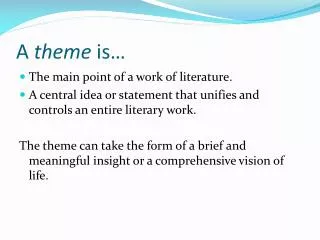
A theme is… • The main point of a work of literature. • A central idea or statement that unifies and controls an entire literary work. The theme can take the form of a brief and meaningful insight or a comprehensive vision of life.
In fables, it is the moral of the tale: • In The Tortoise and the Hare, the moral or theme is “slow and steady wins the race.”
In Beauty and the Beast, we see that the power of love is stronger than the power of an evil curse.
Think about the themes in Romeo & Juliet. • Love cannot survive in a climate of hatred and violence. • Young love can be impulsive and foolish. • Secrecy and lying can lead to sorrow and pain.
Or, think about Night. • Humans can do unspeakably cruel acts when they choose to see another human being as less than human. • Man will do anything to survive, even betray and neglect his own family and friends.
In shorter personal expressive writing, writers often recount a specific incident from their lives and then expand on that as they find a larger meaning in the event. • Read “The Cookies” which is attached to this Wiki page. • Answer the question about the theme of the passage, then complete the learning task asked.