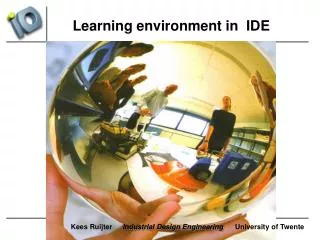
Learning environment in IDE
Learning environment in IDE. Kees Ruijter Industrial Design Engineering University of Twente. Learning environment in IDE. Final qualifications Learning activities Instructional activities Learning environment.

Learning environment in IDE
E N D
Presentation Transcript
Learning environment in IDE Kees Ruijter Industrial Design Engineering University of Twente
Learning environment in IDE • Final qualifications • Learning activities • Instructional activities • Learning environment Kees Ruijter Industrial Design Engineering University of Twente
The educational concept • Competences: learn to • design • solve problems • By means of: • projects team work • learning by doing • just in time instruction • peer teaching Kees Ruijter Industrial Design Engineering University of Twente
Student centred education Kees Ruijter Industrial Design Engineering University of Twente
The learning environment • Permanent learning environment • 16 hours a day access • a lot of group or team work • assignments driven • secondary school: • no homework (not self-governing) • not able to listen to teachter for two hours • teacher comes to the students work place Kees Ruijter Industrial Design Engineering University of Twente
flexibility: in time alternating activities listening exercising subgroup discussing plenary explanation of high lights • student is ‘in the picture’ commitment • at any moment of the day there can be: • a lecture (all, plenary) • tutorials (25 per subgroup per instructor) • projectgroup (8, with or without tutor) • individual study (1) Teacher comes to the students work place Kees Ruijter Industrial Design Engineering University of Twente
The computer in engineering education • PC is essential tool / device for engineers • calculation: analytical tools • simulation, modeling: numerical tools • experimentation: measurement device • technical drawing: CAD, CAM, • 3D-printing, virtual reality • professional software from day one • PC is essential for any academic • word processing • communication with server, through internet Kees Ruijter Industrial Design Engineering University of Twente
The added value of laptops • The educational concept requires that every student has access to a PC in the ‘permanent and flexible learning environment’ • notebook is more flexible • requires less m2 • can be incorporated in group work (plenary modeling exercise with computer • reduce costs for the university • requires less m3 (less heat production) Students care more for there own equipment than for ours Kees Ruijter Industrial Design Engineering University of Twente
The added value of wireless • Flexibility • independent of the place • Everywhere access to common work space, to ELO (Teletop) etc. • see slides of lectures on own monitor and can make notes on it; • teacher can monitor progress of students working on a project; • teacher can show a certain product of a student for the whole group • quizes to check progress • Etc. Kees Ruijter Industrial Design Engineering University of Twente
Students opinions after 4 months • 60%: positive that every student has one • 25%: the laptop can be used more, and/or more productive • 25%: the price is the problem • 85%: well aware of RSI risks • 85%: notebook distracts attention for study • 60%: faculty should take measures like preventing access to internet at certain periods of the day Kees Ruijter Industrial Design Engineering University of Twente
Crucial factors • Educational concept: • if you do not use alternating instructional methods a multifunctional is not optimal • if students do not need eachother (teamwork)… • if the final qualifications are ‘to know..’ rather than to be able to… • Standard configuration: same laptop for every student • Include: assurance, service etc additional costs difficult to compare with the ‘Aldi’ • A laptop is just a tool Kees Ruijter Industrial Design Engineering University of Twente
Questions?? Kees Ruijter Industrial Design Engineering University of Twente