Chemical Reactions: Types and Balancing Equations
490 likes | 514 Vues
Learn about chemical reactions, reactants, products, types of reactions, balancing equations, and evidence of reactions. Explore precipitation reactions, ionic compounds, solubility rules, hydration, and net ionic equations.


Chemical Reactions: Types and Balancing Equations
E N D
Presentation Transcript
Chemistry 100 Chapter 7 Chemical Reactions
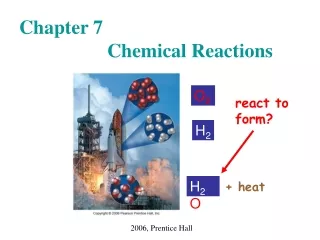
Chemical Reactions Chemical change = Chemical reaction Substance(s) is used up (disappear) New substance(s) is formed. Different physical and chemical properties.
Evidence for chemical reactions • Color changes • A solid is formed (precipitation) • Bubbles form (gas) • Heat (and/or flame) is produced, or heat is absorbed
Chemical Reactions A + B C + D Reactants Products Chemical Equation
Chemical Reactions Products contain the same atoms as reactants. Rearrangement of atoms
Solid (s) Liquid (l) Gas (g) Aqueous (aq) Ca(OH)2(s) + 2HCl(g) CaCl2(s) + H2O(l) Chemical Equation Physical States (forms)
Chemical Equation Chemical equation gives us some information: • Identities of the reactants and products. • Relative amounts of the reactants and products. • Physical states of the reactants and products. • Stoichiometry
AB A + B 2. Decomposition (analysis) 2NaCl 2Na + Cl2 A + BC AC + B 3. Single replacement reaction Fe + CuSO4 FeSO4 + Cu AB + CD AD + CB 4. Double replacement reaction NaCl + AgNO3 NaNO3 + AgCl Type of chemical reactions A + B AB 1. Synthesis reaction (combination) 2H2 + O2 2H2O
Type of chemical reactions 5. AB + xO2 yCO2 + zH2O + Heat (Energy) Combustion C3H8 + 5O2 3CO2 + 4H2O + Heat
Balance a chemical equation All chemical equations should be balanced. Why balancing?
Balance a chemical equation Law of conservation of mass Atoms are neither destroyed nor created. They shift from one substance to another.
Balance a chemical equation • Begin with atoms that appear in only one compound on the left and right. • If an atom occurs as a free element, balance it last. • Change only coefficients (not formulas). C3H8(g) + O2(g) CO2(g) + H2O(g) last Always double check!
Balance a chemical equation C3H8(g) + 5O2(g) 3CO2(g) + 4H2O(g) 2C3H8(g) + 10O2(g) 6CO2(g) + 8H2O(g) 2 3C3H8(g) + 15O2(g) 9CO2(g) + 12H2O(g) 3 Lowest set of numbers
Examples for Balancing __ C2H5OH(l) + __ O2(g) __ CO2(g) + __ H2O(g) 2 1 3 3 __ PbCl2(aq) + __ K2SO4(aq) __ PbSO4(s) + __ KCl(aq) 1 2 1 1 __ CaC2(s) + __ H2O(l) __ Ca(OH)2(s) + __ C2H2(g) 2 1 1 1
Examples for Balancing 2 3/2 1 __ Fe(s) + ____ O2(g) __ Fe2O3(s) 3 4 2 2 3/2 1 __ Fe(s) + ____ O2(g) __ Fe2O3(s) Notes:Always use the lowest possible integer numbers. If you get a fraction, multiply it out.
Examples for Balancing 2 11 4 10 __ B4H10(g) + ____ O2(g) __ B2O3(g) + __ H2O(g) 2 1 11/2 5
Examples for Balancing • “Solid potassium reacts with water to form hydrogen gas and potassium hydroxide dissolved in solution.” • Write and balance the chemical equation for this reaction. 2 K(s) + H2O(l) → KOH(aq) + H2(g) 1 1 1 2 2
Why does a chemical reaction occur? Several driving forces: • Formation of a solid • Formation of water • Transfer of electrons • Formation of a gas
Why does a chemical reaction occur? Several driving forces: • Formation of a solid • Formation of water • Transfer of electrons • Formation of a gas
Reactions in Aqueous Solutions Ionic compounds (Salt) Aqueous solution: solvent is water
Reactions in Aqueous Solutions Chemical reactions that occur in water. 60% of our body is water. In our body reactions occur in the aqueous solution.
Formation of a solid Precipitation reactions Precipitate KI + Pb(NO3)2 ?
Ionic Compounds When an ionic compound dissolves in water, ions are produced. Each ion is surrounded by water molecules. Ions Hydrated by H2O Hydration
Ionic Compounds 1. Soluble ionic compound: it completely dissociates in water. (ions are formed) 2. Slightly soluble ionic compound: it partially dissociates in water. 3. Insoluble ionic compound: it does not dissociate in water (almost). • Note: the terms insoluble and slightly solublemean such a miniscule amount dissolves that you can’t see any decrease in the amount of solid present.
Solubility Rules Soluble Insoluble Preceding rules trump following rules.
Solubility Rules • Another way of showing the same rules. Soluble Insoluble
Formation of a solid Precipitation reactions Precipitate KI + Pb(NO3)2 ?
Aqueous Solution(ionic compounds) aqueous solution: solvent is water H2O Dissociation (Ionization) KI(s) K+(aq) + I-(aq) KI K+ I- Pb(NO3)2 H2O Pb(NO3)2(s) Pb2+(aq) + 2NO3-(aq) NO3- Pb2+ NO3-
Aqueous Solution(ionic compounds) Sometimes the ions react with each other. Positive ions will interact with negative ions. KI Pb(NO3)2 K+ I- Pb2+ NO3- Sometimes ions stick together to form a solid (precipitate). 2KI(aq) + Pb(NO3)2(aq) PbI2(s) + 2KNO3(aq)
2KI(aq) + Pb(NO3)2(aq) PbI2(s) + 2KNO3(aq) Molecular equation: Complete Ionic equation: 2K+(aq) + 2I-(aq) + Pb2+(aq) + 2NO3-(aq) PbI2(s) + 2K+(aq) + 2NO3-(aq) 2K+(aq) + 2I-(aq) + Pb2+(aq) + 2NO3-(aq) PbI2(s) + 2K+(aq) + 2NO3-(aq) Spectator ions Net ionic equation: Pb2+(aq) + 2I-(aq) PbI2(s) • The ions that do not react are called spectator ions.
Ionic Equations Total charge on left side = Total charge on right side balanced equation Net ionic equation: Pb2+(aq) + 2I-(aq) PbI2(s) 2As3+(aq) + 3s2-(aq) As2S3(s)
Example Pb(NO3)2(aq) + Na2SO4(aq) ? Pb(NO3)2(aq) + Na2SO4(aq) PbSO4 + NaNO3 Balance it: Pb(NO3)2(aq) + Na2SO4(aq) PbSO4 + 2 NaNO3 Find the form from solubility table: Pb(NO3)2(aq) + Na2SO4(aq) PbSO4(s) + 2 NaNO3(aq) • Pb2+(aq) + 2 NO3-(aq) + 2 Na+(aq) + SO42-(aq) PbSO4(s) + 2 Na+(aq) + 2 NO3-(aq) Complete ionic equation
Example Pb2+(aq) + 2 NO3-(aq) + 2 Na+(aq) + SO42-(aq) PbSO4(s) + 2 Na+(aq) + 2 NO3-(aq) Spectator ions Net ionic equation: • Pb2+(aq) + SO42-(aq) PbSO4(s)
Practice • Molecular equation KOH(aq) + Fe(NO3)3(aq) ? • Balancing • Complete ionic equation • Net ionic equation
Why does a chemical reaction occur? Several driving forces: • Formation of a solid • Formation of water • Transfer of electrons • Formation of a gas
Acids and Bases Acids: sour Bases: bitter or salty
Acid-Base Reactions Neutralization Strong acid + Strong base → Salt + H2O HCl(aq) + NaOH(aq) NaCl(aq) + H2O(l) H+(aq) + Cl-(aq) + Na+(aq) + OH-(aq) Na+(aq) + Cl-(aq) + H2O(l) H+(aq) + OH-(aq) H2O(l) The only chemical change is the formation of water.
Why does a chemical reaction occur? Several driving forces: • Formation of a solid • Formation of water • Transfer of electrons • Formation of a gas
Oxidation and Reduction reactions (redox) e- 2Na(s) + Cl2(g) 2NaCl(s) Na → Na+ + e- Cl + e-→ Cl-
Oxidation and Reduction reactions (redox) oxidation:it is the loss of electrons. reduction:it is the gain of electrons. Na → Na+ + e- Cl + e-→ Cl- Remember – LEO says GER. Loss of Electrons is Oxidation Gain of Electrons is Reduction.
Oxidation and Reduction reactions (redox) Metal + Nonmetal : Transfer of electrons Oxidation and Reduction reactions (redox) Oxidation and reduction alwaysoccur together. (The lost e- must go somewhere!)
Oxidation and Reduction reactions (redox) oxidation:it is the loss of electrons. reduction:it is the gain of electrons. Zn(s) + Cu2+(aq) Zn2+(aq) + Cu(s) redox reaction Zn(s) Zn2+(aq) + 2e- Zn is oxidized (reducing agent) Cu2+(aq) + 2e- Cu(s) Cu2+ is reduced (oxidizing agent)
Oxidation and Reduction reactions (redox) oxidation:is the gain of oxygen / loss of hydrogen. reduction:is the loss of oxygen / gain of hydrogen. CH4(s) + 2O2(g) CO2(g) + 2H2O(g) redox reaction C gains O and loses H is oxidized (reducing agent) O gains H Is reduced (oxidizing agent) single replacement reaction and combustion reactions redox reactions double replacement reactions non redox
Oxidation and Reduction reactions (redox) Example 2: • 2 Al(s) + Fe2O3(s) 2 Fe(s) + Al2O3(s) • Called the Thermite reaction. • Let’s just say it’s vigorous! is oxidized is reduced
Oxidation and Reduction reactions (redox) Example 3: is oxidized is reduced Cu(s) + 2 Ag+(aq) 2 Ag(s) + Cu2+(aq)
Oxidation and Reduction reactions (redox) Example 4: Zn(s) + 2 HCl(aq) H2(g) + ZnCl2(aq) Zn(s) + 2 H+(aq) + 2Cl-(aq) H2(g) + Zn2+(aq) + 2Cl-(aq) is oxidized is reduced Zn(s) + 2 H+(aq) H2(g) + Zn2+(aq) Note: this reaction also shows the fourth driving force of a reaction, namely, the formation of a gas.
Oxidation and Reduction reactions (redox) Example 5: 2 Mg(s) + O2(g)2 MgO(s) is oxidized is reduced
Classification of chemical reactions Chemical reactions Precipitation Reactions Oxidation-Reduction Reactions Acid-Base Reactions Synthesis (combination) Reactions (Reactants are elements.) Decomposition (Analysis) Reactions (Products are elements.) Combustions Reactions