Download
1 / 26
260 likes | 381 Vues
Recombinant DNA technology involves linking genes from two different sources to create new genetic combinations for practical uses. This genetic engineering process allows scientists to manipulate organisms or their components to perform tasks or produce useful products. Key concepts include bacterial genetics, cloning, and the use of restriction enzymes for DNA manipulation. Applications range from disease diagnosis and human gene therapy to the development of vaccines and genetically modified organisms (GMOs). This field is crucial for advancements in medicine, agriculture, and forensic science.

E N D
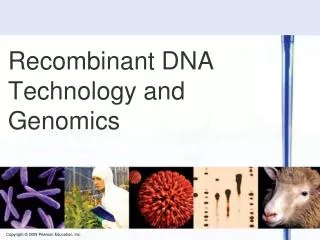
Recombinant DNA • Definition: DNA in which genes from 2 different sources are linked • Genetic engineering: direct manipulation of genes for practical purposes • Biotechnology: manipulation of organisms or their components to perform practical tasks or provide useful products
Bacterial genetics • Nucleoid: • region in bacterium densely packed with DNA (no membrane) • Plasmids: • small circles of DNA • Reproduction by binary fission (asexual)
Bacterial DNA-transfer processes • Transformation • genotype alteration by the uptake of naked, foreign DNA from the environment (Griffith expt.) • Transduction • phages that carry bacterial genes from 1 host cell to another • generalized~ random transfer of host cell chromosome • specialized~ incorporation of prophage DNA into host chromosome • Conjugation • direct transfer of genetic material; cytoplasmic bridges • pili; sexual
Bacterial Plasmids • Small, circular, self-replicating DNA separate from the bacterial chromosome • F (fertility) Plasmid: codes for the production of sex pili (F+ or F-) • R (resistance) Plasmid: codes for antibiotic drug resistance
Bacterial plasmids in gene cloning • Clone genes for insertion into organisms • Clone proteins for medical/ pharmaceutical purposes
DNA Cloning • Restriction enzymes (endonucleases) • in nature, these enzymes protect bacteria from intruding DNA • they cut up the DNA (restriction) • very specific • Restriction site • recognition sequence for a particular restriction enzyme • Restriction fragments • segments of DNA cut by restriction enzymes in a reproducable way • Sticky end • short extensions of restriction fragments • DNA ligase • enzyme that can join the sticky ends of DNA fragments • Cloning vector • DNA molecule that can carry foreign DNA into a cell and replicate there (usually bacterial plasmids)
Eukaryotic Gene Cloning • Isolation of cloning vector (bacterial plasmid) & gene-source DNA (gene of interest) • Insertion of gene-source DNA into the cloning vector using the same restriction enzyme; bind fragmented DNA w/ DNA ligase • Introduction of cloning vector into cells (transformation by bacterial cells) • Cloning of cells (and foreign genes) • Identification of cell clones carrying the gene of interest
Genomic Libraries • Cloned genes from a genome are stored in a “genomic library” • Recombinant fragments in bacteria or phages • Complimentary DNA (cDNA) Library • mRNA extracted • Reverse transcriptase makes a complimentary strand of gene
DNA Analysis • PCR (polymerase chain reaction) • Gel electrophoresis • Restriction fragment analysis (RFLPs) • Southern blotting • DNA sequencing
Practical DNA Technology Uses • Diagnosis of disease • Human gene therapy • Pharmaceutical products • Vaccines • Hormones • Forensics • Crime scene analysis of DNA • Animal husbandry (transgenic organisms) • “Pharm” animals • Genetic engineering in plants • Disease/ pest resistance
Polymerase chain reaction (PCR) • Amplification of any piece of DNA without cells (in vitro) • Materials: heat, DNA polymerase, nucleotides, single-stranded DNA primers • Applications: fossils, forensics, prenatal diagnosis, etc.
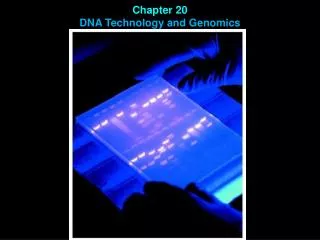
DNA Analysis • Gel electrophoresis: • separates nucleic acids or proteins on the basis of size or electrical charge creating DNA bands of the same length
Restriction fragment analysis • Restriction fragment length polymorphisms (RFLPs) • Differences in restriction fragment patterns on homologous chromosomes • Occur in noncoding DNA sequences • Serve as inheritable genetic markers • Southern blotting: process that reveals sequences and the RFLPs in a DNA sequence • DNA Fingerprinting
DNA Sequencing • Determination of nucleotide sequences • Dideoxy Chain-Termination Method (Sanger Method) • Whole-genome approach (Venter and Celera Genomics) • Genomics: the study of genomes based on DNA sequences • Human Genome Project • Begun in 1990; largely completed by 2003
Genomics • The National Center for Biotechnology Information (NCBI) • Created a database of gene sequences created by the Human Genome Project and other sequencing endeavors • Genbank • BLAST software allows for comparison of sequences
Analyzing Gene Expression • Northern Blotting • Gel electrophoresis done with labeling probes to determine function • RT-PCR • Uses reverse transcriptase and PCR • Compares gene expression between different samples
Studying Gene Interaction • DNA Microassay • Many DNA fragments on a glass slide or chip • Can be tested for interaction with other genes marked with fluorescent markers
Determining Gene Function • In vitro mugagenasis • Disable certain genes and observe consequences • Mutations “knock out” certain genes • RNA interference (RNAi) • RNA used to block translation of certain genes
Transposons • transposable genetic element; piece of DNA that can move from location to another in a cell’s genome • chromosome to plasmid, plasmid to plasmid, etc.) • “jumping genes”
Eukaryotic Genes • 98.5% of all DNA does not code for proteins, rRNA, or tRNA • Most is repetitive DNA • 44% is made of transposable elements
Transposable Elements • Transposons • Move w/in a genome by DNA intermediate • Barbara McClintock (1940’s and 50’s) • “Jumping genes” • Researched the location of colored kernels in maize • Retrotransposons • Move by means of a RNA intermediate
Multigene Families • In the human genome, ½ of coding DNA is in multigene families • Collections of identical or very similar genes • Identical- ribosomal RNA molecules • Similar- α-globin and β-globin • Pseudogenes- nonfunctional nucleotide sequences (very similar to functional genes)
Genome Evolution • Duplications of chromosomes • Unequal crossing over • Duplication and divergence of DNA segments • Ancestral globin gene present day α-globin and β-globin genes • Rearranging genes • Exon duplication/ exon shuffling • Transposable elements