Understanding Central and Inscribed Angles with Intersecting Chords
In this lesson, we explore the fascinating world of angles created by intersecting chords in a circle. When two chords intersect within a circle, they form four angles. We learn how to measure these angles, specifically central angles and inscribed angles. Through visual examples and step-by-step methods, we derive the formulas to find the measures of angles formed by intersecting chords, including how to use the relationships between opposite angles. Complete the in-class assignment to test your understanding!


Understanding Central and Inscribed Angles with Intersecting Chords
E N D
Presentation Transcript
Interior Angles We learned about two, now here comes the third
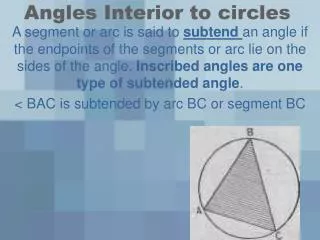
Central Angle & Inscribed Angle chord radius
Measuring the angles created by intersecting chords Definition of Intersecting Chords D • When two chords cross each other within a circle, their intersection creates four angles. How can we measure these angles? The vertex is not in the center, nor is it on the circle. A 4 1 3 2 C B
Measuring the angles created by intersecting chords D • First we see that ∡1 and ∡3 are opposite angles, so ∡1 = ∡3 • ∡2 and ∡4 are also opposite angles, so ∡2 = ∡4 • This means there are really only two angle measures to find! A 4 2 1 1 3 2 C B
How to Find∡1 D • Make a triangle with ∡2, ∡B, and ∡C. • ∡B is an inscribed angle capturing DC • ∡C is an inscribed angle capturing AB • ∡B = ½mDC and ∡C = ½mAB A 2 1 1 2 ½ AB ½ DC C B
How to Find∡1 D • Then since it is a triangle, m∡B + m∡C + m∡2 = 180 ̊ • We notice that ∡1 and ∡2 are a linear pair, m∡1 + m∡2 = 180 ̊ • This means… m∡1+m∡2=m∡B+m∡C+m∡2 • Cancel like terms to get m∡1= m∡B + m∡C • Which means that m∡1= ½mAB + ½mDC. A 2 1 1 2 ½ AB ½ DC C B
The formula for finding the measure of an angle created by intersecting chords m∡1 =½mAB+ ½mCD Which can also be written as m∡1 =½(mAB+ mCD)
m∠1 =½( mAB + mCD ) A D 1 1 C B
m∠1 =½( mAB 40° + mCD ) + 30° ) = 35° A D 1 1 30° 40° C B
m∠2 =½( mAD + mBC ) A D 2 30° 35° m∠1=35° 40° 2 C B
m∠2 =½( 210° mAD + mBC ) + 80° ) = 145° 210° A D 2 35° 30° 35° 40° 2 C 80° B
m∠5 =½( 170° + 90° ) = 130° mAD + mBC ) m∠4 = 180° – 130° = 50° 170° A D 5 4 C 90° B
In Class Assignment Watch the screen, answer the questions in your notebook (10 questions total)