Introduction to Piecewise Polynomial Spaces and Continuous Linear Functions
This text explores the construction of piecewise polynomial function spaces over a domain, highlighting their significance in mathematical analysis. We define linear functions in two dimensions and provide examples related to triangular domains, showcasing how linear functions can be uniquely determined by nodal values. Additionally, we discuss local basis functions, continuous piecewise linear polynomials, and their interpolation properties, emphasizing the mathematical framework that supports these concepts. Exercises are included for practical understanding and application of these principles.

Introduction to Piecewise Polynomial Spaces and Continuous Linear Functions
E N D
Presentation Transcript
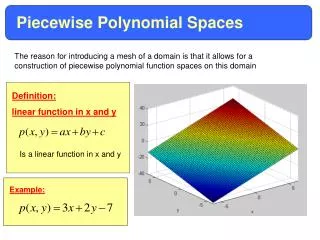
Piecewise Polynomial Spaces The reason for introducing a mesh of a domain is that it allows for a construction of piecewise polynomial function spaces on this domain Definition: linear function in x and y Is a linear function in x and y Example:
Piecewise Polynomial Spaces Definition: triangle with nodes be the space of linear functions on We observe that any member in is uniquely determined by its nodal values Remark: Find a linear polynomial on the triangle K such that p(N1)=2 , p(N2) = 3, p(N3)=1 Example:
Local basis functions Example: Find a linear function on the triangle K such that p(N1)=2 , p(N2) = 3, p(N3)=1 Example: Find a linear function on the triangle K such that p(N1)=1 , p(N2) = 0, p(N3)=0 p(N1)=0 , p(N2) = 1, p(N3)=0 p(N1)=0 , p(N2) = 0, p(N3)=1 Example: Remark: any member in can be expressed as a linear combination of these three functions
Local basis functions The local basis functions for the triangle K are
Reference triangle Local basis functions Exercise3 Find three linear functions on the reference triangle such that Then find a linear function on the reference triangle K such that p(0,0)=2 , p(1,0) = 3, p(0,1)=1
Continuous Piecewise Polynomial Spaces Definition: the space of all continuous functions Definition: be a triangulation of the space of all continuous piecewise linear polynomials An example of a continuous piecewise linear function
Global Basis Functions for the space of all continuous piecewise linear polynomials To construct a basis for this space we note that a function v in this space is uniquely determined by its nodal values where n is the number of nodes in the mesh
2 6 1 11 10 7 5 9 12 13 3 8 4 global basis functions
2 6 1 11 10 7 5 9 12 13 3 8 4 global basis functions
2 6 1 0 0 0 0 11 10 0 0 0 7 5 9 0 0 12 13 0 0 0 3 8 4 global basis functions
6 2 14 3 5 10 11 15 9 13 12 7 1 16 4 8
2 6 1 0 0 11 10 0 0 7 5 9 0 0 0 12 13 0 0 0 3 8 4 Exercise4: Find in explicit form
Continuous Piecewise Linear Interpolation Definition: Let we define its continuous piecewise linear interpolant by Remark: approximates by taking on the same values in the nodes Ni.
to draw πf given f [p,e,t] = initmesh('squareg','hmax',0.7); % mesh x = p(1,:); y = p(2,:); % node coordinates pif = x.^2+ y.^2; % nodal values of interpolant pdesurf(p,t,pif') % plot interpolant %pdeplot(p,e,t,'xydata',pif,'zdata',pif,'mesh','on');
Reference triangle Piecewise Polynomial Spaces Definition: triangle with nodes be the space of linear functions on Remark: We observe that any function inP1(K) is uniquely determined by its nodal values