
SlideServe
Menu
Préférences
© SlideServe · v2026

Treatment

raven-good avatar
9 diapositives · 257 Views · Nov 07, 2014

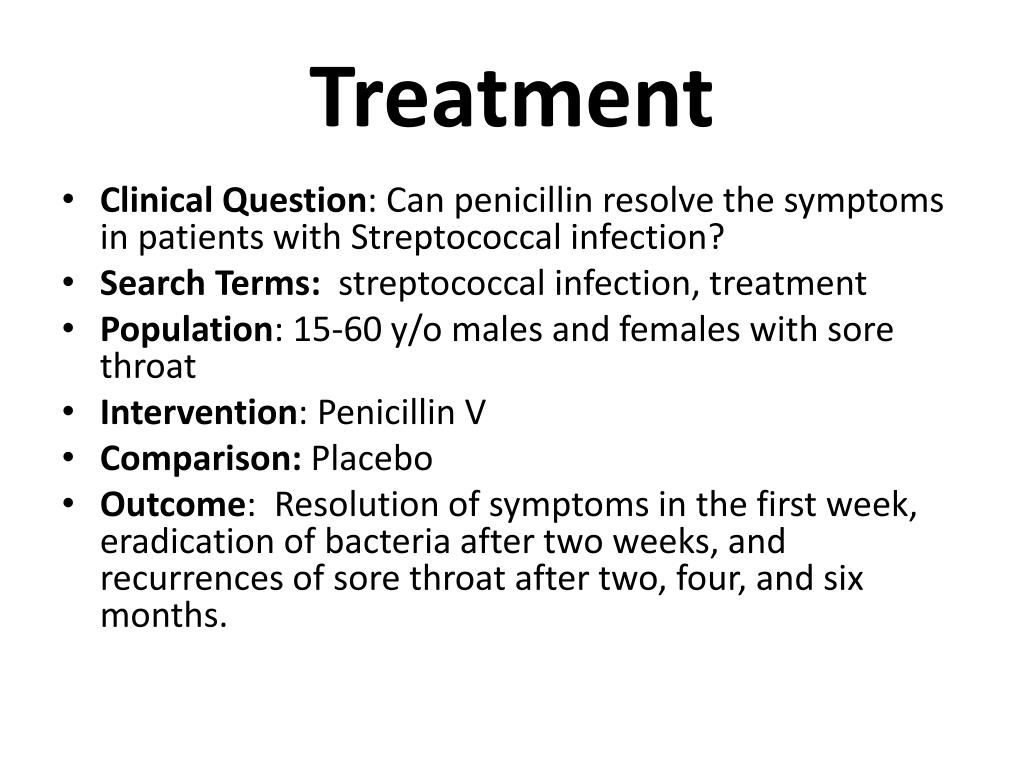
Treatment. Clinical Question : Can penicillin resolve the symptoms in patients with Streptococcal infection? Search Terms: streptococcal infection, treatment Population : 15-60 y/o males and females with sore throat Intervention : Penicillin V Comparison: Placebo
Treatment - slide 1
01 / 9Treatment
1 / 17

Télécharger la présentation

Treatment
Une image / un lien ci-dessous est fourni (tel quel) pour télécharger la présentation

Politique de téléchargement : le contenu du site vous est fourni TEL QUEL pour votre information et votre usage personnel ; il ne peut être vendu, concédé sous licence ni partagé sur d’autres sites sans l’accord de son auteur.Le contenu vous est fourni TEL QUEL, pour votre information et votre usage personnel uniquement. Téléchargez la présentation en cliquant sur ce lien. Lors du téléchargement, si vous ne parvenez pas à télécharger une présentation, l’éditeur a peut-être supprimé le fichier de son serveur.Pendant le téléchargement, si vous ne parvenez pas à obtenir une présentation, le fichier a peut-être été supprimé par l’éditeur.

F I N

Plus de contenu associé

Transcription de la présentation
  1. Treatment • Clinical Question: Can penicillin resolve the symptoms in patients with Streptococcal infection? • Search Terms: streptococcal infection, treatment • Population: 15-60 y/o males and females with sore throat • Intervention: Penicillin V • Comparison: Placebo • Outcome: Resolution of symptoms in the first week, eradication of bacteria after two weeks, and recurrences of sore throat after two, four, and six months.

  2. Penicillin for acute sore throat: randomised double blindtrial of seven days versus three days treatment or placeboin adultsSjoerdZwart, Alfred P E Sachs, Gijs J H M Ruijs, Jan W Gubbels, Arno W Hoes, Ruut A de MelkerBMJ 2000;320:150–4 • Validity Guides • Was the assignment of patients to treatment randomized? Was randomization concealed? • Yes. Patients were randomly assigned to one of three treatment groups: penicillin V for seven days, penicillin V for three days followed by placebo for four days, or placebo for seven days. The dosage was two 250 mg capsules three times daily. Paracetamol tablets were supplied to all patients to be used on demand. (Participants and Methods, Treatment Groups, p. 151) • Was the follow up sufficiently long and complete? • Yes. Fourteen days after inclusion the patients were re­examined by their general practitioner. After two, four, and six months the patients were interviewed by telephone on recurrent sore throat and other complaints of the respiratory tract.(Participants and Methods, Clinical Follow-up, p. 151)

  3. Was the data analyzed on an intention-to-treat basis? • Yes. All analyses were carried out with spss version 7.0, using an intention to treat approach. (Participants and Methods, Data Analysis, p. 151) • Was there adequate blinding of subjects and researchers? • Randomised double blind placebo controlled trial. (Abstract, Design, p. 150) • Were there similar baseline characteristics in each group? • Yes. Refer to table 1. • Groups treated equally other than intervention? • Yes.

  4. Clinical Importance • What is the magnitude of treatment effect? • Endpoint: Sore throat (duration)   There is a -32% relative risk reduction in the end point sore throat using the 7-day penicillin V treatment. The relative risk (EER/CER) for penicillin is 132%. And we need to harm 4 (NNT= -4) patients to prevent shortening of sore throat duration. • Endpoint: bacterial eradication • There is a -929% relative risk reduction of bacterial eradication using the 7-day penicillin V treatment. The relative risk (EER/CER) for penicillin is 1028.6%. And we need to harm 2 (NNT= -2) patients to prevent bacterial eradication. • Endpoint: Sore throat (recurrence) • There is a -75% relative risk reduction in the recurrence of sore throat using the 7-day penicillin V treatment. The relative risk (EER/CER) for penicillin is 175%. And we need to harm 17 (NNT= -17) patients to prevent recurrence of sore throat.

  5. Relevance • Is the objective of the article comparing therapeutic interventions similar to your clinical dilemma? • Yes, one of the initial steps in the management of acute rheumatic fever is to eradicate the infecting agent (Group A Beta Hemolytic Streptococci). • External Validity • Are The Results of the Study Applicable to the Patient? • Yes. The patient is included within the age range of the study subjects. Both male and female subjects were used in the study. The patient also has history of recurrent streptococcal throat infections since childhood. • Were All Clinically Important Outcomes Considered? • Yes, resolution of symptoms, bacteriological response and recurrences and adverse effects. (Results, p. 152)

  6. Is treatment feasible? • Yes. Penicillin V is readily available and the response to the treatment is easily monitored. • Patient preferences • The patient may be informed of the different interventions and allowed to choose what she prefers. • Benefit vs. harm • According to the study’s results, there is a 24% reduction in duration of sore throat, 65% difference in eradication of bacteria and 6% difference in incidence of recurrence of sore throat in patients treated with penicillin compared to placebo. 

  7. Resolution • The bottom line of this clinical study is that a 7-day course of penicillin is effective in resolving the symptoms in patients with Streptococcal infection of the throat.