

SlideServe
Menu
Préférences
© SlideServe · v2026

Scan gun returns

raven avatar
11 diapositives · 264 Views · Apr 02, 2014

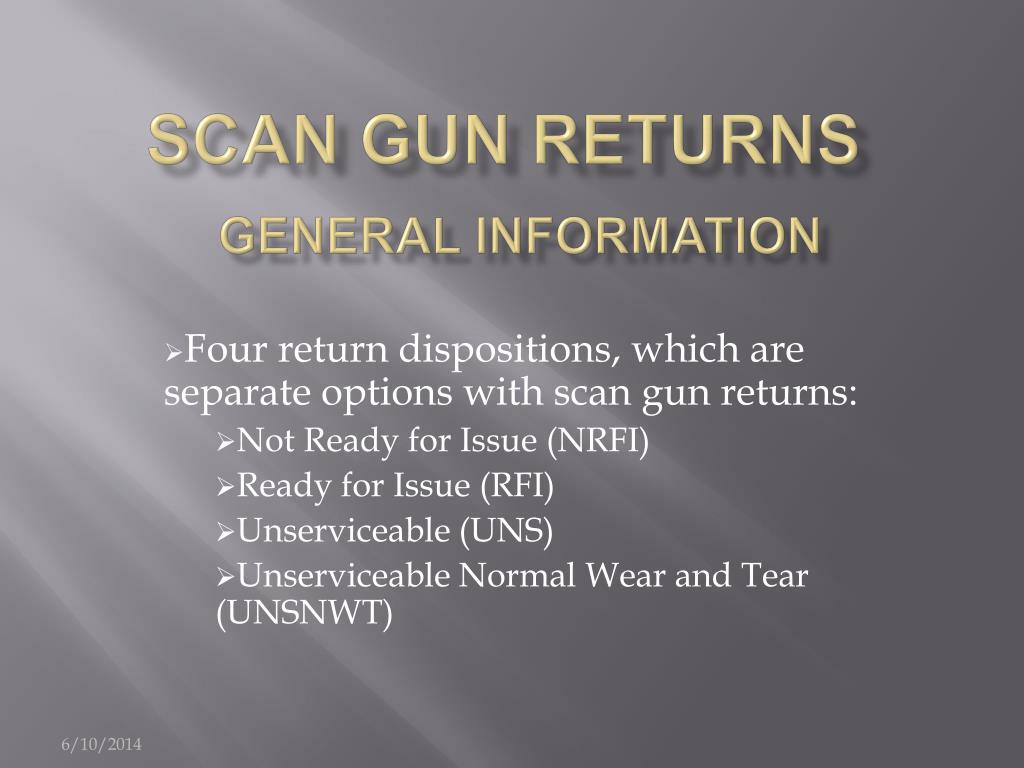
Scan gun returns. General Information. Four return dispositions, which are separate options with scan gun returns: Not Ready for Issue (NRFI) Ready for Issue (RFI) Unserviceable (UNS) Unserviceable Normal Wear and Tear (UNSNWT). A Cache can have one of two Return Nodes:.
Scan gun returns - slide 1
01 / 11Scan gun returns
1 / 17

Télécharger la présentation

Scan gun returns
Une image / un lien ci-dessous est fourni (tel quel) pour télécharger la présentation

Politique de téléchargement : le contenu du site vous est fourni TEL QUEL pour votre information et votre usage personnel ; il ne peut être vendu, concédé sous licence ni partagé sur d’autres sites sans l’accord de son auteur.Le contenu vous est fourni TEL QUEL, pour votre information et votre usage personnel uniquement. Téléchargez la présentation en cliquant sur ce lien. Lors du téléchargement, si vous ne parvenez pas à télécharger une présentation, l’éditeur a peut-être supprimé le fichier de son serveur.Pendant le téléchargement, si vous ne parvenez pas à obtenir une présentation, le fichier a peut-être été supprimé par l’éditeur.

F I N

Plus de contenu associé

Transcription de la présentation
  1. Scan gun returns General Information Four return dispositions, which are separate options with scan gun returns: Not Ready for Issue (NRFI) Ready for Issue (RFI) Unserviceable (UNS) Unserviceable Normal Wear and Tear (UNSNWT)

  2. A Cache can have one of two Return Nodes: • Remote Returns Process (RRP) node: • Configured as a RRP node when the returns warehouse is physically separated from the main warehouse • Non-Remote Returns Process (Non-RRP) node: • Used in most caches • The returns area is within the main cache/ warehouse building

  3. Return Nodes (cont.) • RRP vs. Non RRP node • RRP (Remote Return Process node): move tasks aren’t automatically generated on a RFI return • Non-RRP (Normal Return Process node): move tasks are automatically generated, on both a RFI and Non RFI return RRP Caches: IDGBK MTNRK IDCDK ORNWK NMSFK Non-RRP Caches: MNNEK AKAKK KYSAK ORLGK AZPFK WAWFK CALSK CANCK CORMK

  4. Regular Returns and LPNs Regular Returns and LPNs • Regular Return: Can be used for both RFI and NRFI returns in a RRP and Non-RRP node. • LPN (License Plate Number): Can be used for both RFI and NRFI returns in an RRP and Non-RRP node. LPN is an abbreviation for “License Plate Number. “ • An LPN is a virtual grouping of several items, which allows us to do mass transactions. • In our case LPN can be used during a RFI or NRFI return. • Once an LPN is created, any transaction performed on an LPN consolidates all the items it holds, thus avoiding the need to re-scan the items a second time for movement to refurb zone/storage.

  5. Regular Return vs. LPN Which to use? • LPN choice consolidates a return into the LPN, therefore, doing away with the need to scan the returned items a second time in the Refurb-RFI zone in a RRP node. • But, you cannot move 50 like items at a time, that you have been holding from a number of returns. • For example: 50 Pulaski's have been returned on 5 different returns. These have been held at the returns warehouse to be ad-hoc moved to the storage location. With LPN, each Pulaski return would need to be moved as part of 5 separate LPN’s. Each LPN would need to be moved separately, therefore negating the ability to physically consolidate like items into 1 Ad-Hoc move.

  6. Regular Return vs. LPN (cont.) • For a regular RFI return, in a RRP node, the items would need to be ad-hoc moved from the return zone Refurb-RFI to the respective storage locations. • In a Non RRP node, putaway tasks are created upon the RFI return from the RFI-1 zone. • For an NRFI regular return, move tasks are created to move the item(s) to their respective refurbishment locations in both the RRP and Non RRP nodes.

  7. Regular Return vs. LPN (cont.) • Using an LPN cancels the put away task in a Non RRP node for a RFI return. Trackable Return: • The user can return a trackable item NRFI, RFI, UNS and UNSNWT using either a LPN or a Regular Return. The return steps are the same, but a Trackable ID entry is required. • Each cache will probably need to determine which method it will use for a trackable return.

  8. Regular Return vs. LPNUNS

  9. Regular Return vs. LPNUNSNWT

  10. Regular Return vs. LPN NRFI

  11. Regular Return vs. LPNRFI