VRF Systems & Copper Joints- Complete Technical Guide
From copper pipe requirements and joint selection to installation procedures, testing, and safety standardsu2014this guide covers everything you need to know for reliable and efficient VRF system installations. ud83dudca1ud83cudf0d<br><br>Whether youu2019re an HVAC professional, engineer, or contractor, discover best practices, troubleshooting tips, and global standards to ensure long-term performance and safety in every project.


VRF Systems & Copper Joints- Complete Technical Guide
E N D
Presentation Transcript
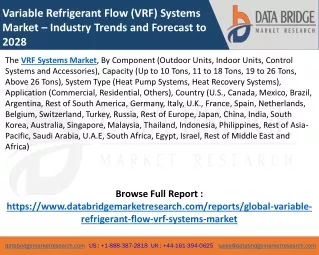
VRF Systems & Copper Joints Complete Technical Guide 1.VRF System Overview 2.Copper Pipe Requirements for VRF 3.Types of Copper Joints 4.Joint Selection Criteria 5.Installation Procedures 6.Quality Control and Testing 7.Common Issues and Solutions 8.Technical Standards and Specifications 9.Best Practices and Safety VRF System Overview What is VRF? Variable Refrigerant Flow (VRF) systems are advanced HVAC technologies that use refrigerant as the cooling and heating medium. They offer precise temperature control, energy efficiency, and flexible zoning capabilities. Key Components ● Outdoor Units: Compressors, condensers, expansion devices ● Indoor Units: Evaporators, fans, controls ● Refrigerant Piping: Copper tubes connecting outdoor and indoor units ● Control Systems: Communication wiring and sensors System Advantages ● Individual zone control ● Energy efficiency (COP 3.0-5.0+) ● Quiet operation www.227enterprise.com sales@227enterprise.com +9199090 67820
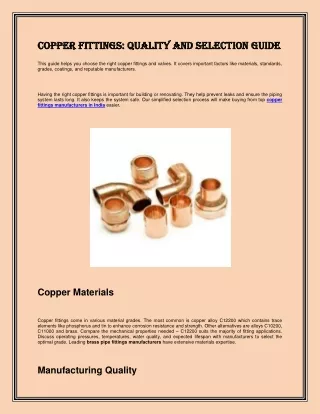
● Flexible installation ● Heat recovery capabilities Copper Pipe Requirements for VRF Material Specifications ● Grade: ASTM B280 (ACR - Air Conditioning and Refrigeration) ● Temper: Hard drawn or annealed ● Purity: 99.9% pure copper (UNS C12200) ● Wall Thickness: Type K or L for pressure requirements Size Range and Applications Pipe Size (OD) Application Max Operating Pressure 1/4" - 3/8" Liquid lines (small capacity) 4.15 MPa (600 psi) 1/2" - 5/8" Liquid lines (medium capacity) 4.15 MPa (600 psi) 3/4" - 7/8" Gas lines (small units) 2.07 MPa (300 psi) 1-1/8" - 2-1/8" Gas lines (large units) 2.07 MPa (300 psi) 2-5/8" - 4-1/8" Main gas lines 2.07 MPa (300 psi) Refrigerant Compatibility ● R-410A: Standard for most VRF systems ● R-32: Newer refrigerant for enhanced efficiency ● R-452B: Low GWP alternative Types of Copper Joints 1. Brazed Joints Description: High-temperature joining using silver-bearing alloy ● Temperature: 1100-1500°F (593-816°C) www.227enterprise.com sales@227enterprise.com +9199090 67820
● Filler Metal: 15% silver alloy (BCuP-3, BCuP-5) ● Applications: All pressure applications, permanent connections Advantages: ● Strongest joint type ● Excellent corrosion resistance ● Suitable for high pressures ● Long-term reliability Disadvantages: ● Requires skilled technician ● Higher cost materials ● Heat-sensitive components need protection 2. Soldered Joints Description: Low-temperature joining using tin-based alloys ● Temperature: 400-500°F (204-260°C) ● Filler Metal: Lead-free solder (Sn96Ag4, Sn95Cu5) ● Applications: Low-pressure applications only Advantages: ● Lower installation temperature ● Less expensive materials ● Easier to learn technique Disadvantages: ● Lower strength than brazing ● Not suitable for high-pressure VRF ● Limited temperature range 3. Mechanical Joints Description: Press-fit or threaded connections without heat www.227enterprise.com sales@227enterprise.com +9199090 67820
● Types: Press-fit fittings, flare fittings, compression fittings ● Applications: Service connections, temporary installations Press-Fit Fittings: ● Tool-pressed O-ring seals ● Quick installation ● Reusable connections ● Temperature rating: -40°F to 250°F Flare Fittings: ● 45° flare connection ● SAE standard dimensions ● Field serviceable ● Common in smaller diameter applications Joint Selection Criteria Pressure Requirements System Type Liquid Line Pressure Gas Line Pressure Recommended Joint Residential VRF Up to 600 psi Up to 300 psi Brazed Commercial VRF Up to 700 psi Up to 350 psi Brazed Large Commercial Up to 800 psi Up to 400 psi Brazed Application Guidelines ● Underground installations: Brazed joints only ● Concealed piping: Brazed joints preferred ● Accessible locations: Mechanical joints acceptable for service ● High-vibration areas: Brazed joints with proper support Size Considerations www.227enterprise.com sales@227enterprise.com +9199090 67820
● ≤ 1-1/8" diameter: All joint types applicable ● > 1-1/8" diameter: Brazed joints recommended ● Main distribution: Brazed joints mandatory Installation Procedures Pre-Installation Preparation Pipe Cutting 1.Use proper tube cutter (not hacksaw) 2.Ensure square, burr-free cuts 3.Deburr inside and outside edges 4.Clean cutting oil residue Surface Preparation 1.Clean pipe ends with emery cloth or wire brush 2.Remove oxidation and contamination 3.Apply flux immediately before joining 4.Avoid touching cleaned surfaces Brazing Procedure Materials Required ● Silver-bearing brazing alloy (BCuP-3 or BCuP-5) ● Flux (for dissimilar metals only) ● Inert gas purging equipment ● Appropriate torch and tips www.227enterprise.com sales@227enterprise.com +9199090 67820
Step-by-Step Process 1.Setup and Safety oEnsure adequate ventilation oWear appropriate PPE oCheck gas cylinder pressures oPosition fire extinguisher nearby 2.Joint Assembly oInsert pipe fully into fitting oEnsure proper gap (0.002-0.005") oSupport both pieces firmly oBegin nitrogen purging (5-10 CFH) 3.Heating Process oHeat joint area uniformly oUse neutral flame oApply heat to thicker section first oAchieve 1150-1400°F joint temperature 4.Filler Metal Application oTouch rod to joint (not flame) oAllow capillary action to draw alloy oFeed alloy around entire joint oRemove heat when joint is filled 5.Cooling and Inspection oContinue nitrogen purging until cool oAllow natural cooling (no quenching) oInspect for complete fill and penetration www.227enterprise.com sales@227enterprise.com +9199090 67820
oCheck for cracks or voids Mechanical Joint Installation Press-Fit Fittings 1.Mark insertion depth on pipe 2.Clean pipe end thoroughly 3.Check O-ring condition 4.Insert pipe to marked depth 5.Use appropriate pressing tool 6.Verify complete press indication Flare Fittings 1.Cut pipe square and deburr 2.Slide flare nut onto pipe 3.Insert pipe into flare tool 4.Create 45° flare per specifications 5.Inspect flare for cracks or irregularities 6.Assemble with proper torque Quality Control and Testing Visual Inspection Criteria Brazed Joints ● Acceptable: Uniform fillet, bright silver color, complete penetration ● Unacceptable: Gaps, flux residue, discoloration, incomplete fill Mechanical Joints ● Press-Fit: Proper insertion depth, visible press marks, no O-ring damage ● Flare: Uniform flare angle, smooth surface, proper torque applied www.227enterprise.com sales@227enterprise.com +9199090 67820
Pressure Testing Test Pressures ● Liquid Lines: 1.5 × operating pressure (minimum 600 psi) ● Gas Lines: 1.5 × operating pressure (minimum 300 psi) ● Test Duration: 24 hours minimum Test Procedure 1.Pressurize with dry nitrogen 2.Apply soap solution to all joints 3.Monitor pressure for 15 minutes initial 4.Extended test for 24 hours 5.Document any pressure loss Leak Detection Methods ● Electronic leak detectors: R-410A specific ● Soap bubble solution: Visual confirmation ● Ultrasonic detectors: High-pressure leaks ● Fluorescent dyes: Trace leak paths Common Issues and Solutions Brazing Problems Incomplete Penetration Causes: Insufficient heat, contaminated surfaces, improper gap Solutions: ● Increase joint temperature ● Improve surface preparation ● Verify proper clearances Oxidation and Contamination Causes: No nitrogen purging, excessive heat, contaminated alloy Solutions: ● Maintain nitrogen flow throughout process www.227enterprise.com sales@227enterprise.com +9199090 67820
● Control heat application ● Use clean brazing materials Joint Leakage Causes: Cold joints, contamination, improper alloy selection Solutions: ● Reheat and add alloy if needed ● Complete surface cleaning ● Verify alloy compatibility Mechanical Joint Issues O-Ring Damage Causes: Improper installation, over-torque, contamination Solutions: ● Replace damaged O-rings ● Follow torque specifications ● Clean connection surfaces Press-Fit Failures Causes: Incomplete press, damaged tools, wrong fitting size Solutions: ● Verify press tool calibration ● Check fitting dimensions ● Complete proper pressing cycle Technical Standards and Specifications International Standards ● ASTM B280: Standard for seamless copper tube for ACR service ● ASTM B88: Standard for seamless copper water tube ● AWS A5.8: Specification for filler metals for brazing Industry Standards ● ASHRAE 15: Safety standards for refrigeration systems www.227enterprise.com sales@227enterprise.com +9199090 67820
● ASME B31.5: Refrigeration piping code ● UL 1995: Heating and cooling equipment standards VRF-Specific Requirements ● Operating Temperature Range: -40°F to 250°F (-40°C to 121°C) ● Pressure Ratings: Up to 800 psi (5.5 MPa) for liquid lines ● Refrigerant Compatibility: R-410A, R-32, R-452B approved materials Quality Certifications ● ISO 9001: Quality management systems ● AHRI: Air-Conditioning, Heating, and Refrigeration Institute ● UL Listed: Underwriters Laboratories certification Best Practices and Safety Installation Best Practices Planning and Design ● Calculate proper pipe sizing using manufacturer software ● Plan installation routes to minimize joints ● Provide adequate support and expansion accommodation ● Consider future service access requirements Workmanship Standards ● Use only trained and certified technicians ● Follow manufacturer installation guidelines ● Maintain clean work environment ● Document all joints and test results System Protection ● Install proper filtration systems ● Use nitrogen for all pressure testing www.227enterprise.com sales@227enterprise.com +9199090 67820
● Maintain system cleanliness throughout installation ● Protect against contamination during construction Safety Requirements Personal Protective Equipment ● Safety glasses with side shields ● Heat-resistant gloves ● Flame-resistant clothing ● Respiratory protection when required Fire Safety ● Maintain fire extinguisher within 25 feet ● Use fire-resistant shields when working near combustibles ● Establish fire watch procedures ● Obtain required permits for hot work Gas Safety ● Check for proper ventilation ● Monitor for refrigerant leaks ● Use appropriate leak detection equipment ● Follow ASHRAE 15 safety requirements Environmental Considerations Refrigerant Handling ● Minimize refrigerant emissions ● Use proper recovery equipment ● Follow EPA regulations for refrigerant use ● Document refrigerant quantities and handling Waste Management www.227enterprise.com sales@227enterprise.com +9199090 67820
● Properly dispose of flux and cleaning materials ● Recycle copper materials when possible ● Handle brazing materials per MSDS requirements ● Maintain clean work areas Maintenance and Service Preventive Maintenance ● Inspect joints annually for signs of deterioration ● Monitor system pressures and temperatures ● Check for refrigerant leaks at all connections ● Maintain system log and documentation Service Procedures ● Use proper lockout/tagout procedures ● Recover refrigerant before opening the system ● Replace components with compatible materials ● Test all work before returning to service Conclusion Successful VRF installation relies on proper copper joint selection, skilled techniques, and strict quality control. Brazed joints remain the most reliable, while mechanical joints suit specific cases. Following standards, using qualified technicians, and thorough testing ensure long-term performance and efficiency. Ongoing training, safety adherence, and staying updated with evolving standards are key to maintaining high-quality installations in the fast-changing VRF market. www.227enterprise.com sales@227enterprise.com +9199090 67820