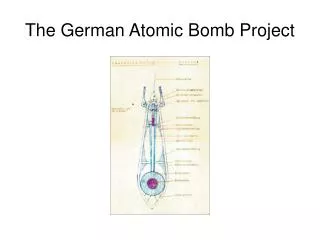
The German Atomic Bomb Project
50 likes | 178 Vues
This timeline explores the German atomic bomb project, chronicling significant events from Hitler's rise to power in January 1933 through the end of World War II in May 1945. Key moments include the discovery of nuclear fission in December 1938, the initiation of the uranium project in September 1939, and the discussions among physicists about plutonium bomb development in 1941. The failure of Germany to develop a functional atomic bomb raises essential debates: Did German scientists sabotage the project? What were the implications of Heisenberg's communications with Bohr? Discover the ongoing intrigue and historical significance of these events.


The German Atomic Bomb Project
E N D
Presentation Transcript
A Timeline • January 1993: Hitler came to power • December 1938: Hahn, Meitner, and Strassmann discovered fission • September 1939: WWII started and German military started uranium project with subsequent active participation by Heisenberg and other physicists • 1941: German physicists discussed plutonium bomb, speculated critical mass (10-100kg); Heisenberg visited Bohr in Copenhagen • 1945: War in Europe ended without Germans succeeding in building a bomb
Key Debates • Why did the Germans fail to make the bomb? • Did Heisenberg and his colleagues deliberately sabotage the German bomb project? • What was Heisenberg trying to tell Bohr in their meeting in Sept. 1941?
Michael Frayn’s Copenhagen • Key point: both historical and epistemological • What did happen in Copenhagen? • Can we ever know what actually happened? • Release of Bohr letters: http://www.nba.nbi.dk/release.html
Most Recent Developments • Farm Hall Transcript of conversations of Heisenberg and other German physicists upon hearing the news of Hiroshima: • http://germanhistorydocs.ghi-dc.org/sub_document.cfm?document_id=2320 • Claim of Germans testing a crude nuclear device during WWII: • http://germanhistorydocs.ghi-dc.org/sub_document.cfm?document_id=2320