Cloud Types and Characteristics: A Comprehensive Guide
100 likes | 200 Vues
Explore how clouds form and learn to identify them in the real world. Discover high, middle, and low-level clouds, as well as formations with vertical development and other unique cloud types. Improve your cloud recognition skills with Latin root word meanings and exercise suggestions.


Cloud Types and Characteristics: A Comprehensive Guide
E N D
Presentation Transcript
Purpose • To discover how clouds form. • To be able to distinguish them in the real world.
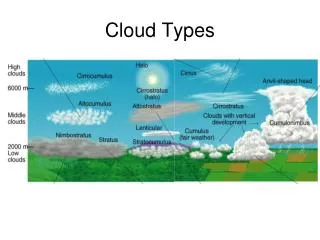
A Quick Overview Latin Root Words and Their Meaning: -Cumulus: Heap -Stratus: Layer -Cirrus: Curl of Hair -Nimbus: Rain
High Level Clouds • Form above 20,000 feet and are mostly composed of ice crystals. • Typically are thin and white in appearance. • The prefix Cirr- denotes clouds in this high layer. • Ex. Cirrostratus, Cirrus, Cirrocumulus Cirrostratus Cirrus Cirrocumulus
Middle Level Clouds • Bases of these clouds are between 6,500 feet and 20,000 feet and are primarily composed of water droplets. • Can be composed of ice crystals when temperatures are cold enough. • The prefix Alto- denotes clouds in this middle layer. • Ex. Altostratus, Altocumulus Altostratus Altocumulus
Low Level Clouds • Bases lay lower than 6,500 feet and are mostly composed of water droplets. • Can be composed of ice particles and snow if temperatures are cold enough. • Some clouds in this layer can precipitate. • Ex. Stratus, Stratocumulus, Nimbostratus Stratus Stratocumulus Nimbostratus
Clouds with Vertical Development • Are created mostly by thermal convection (hot summer days) or frontal lifting (cold fronts). • Can grow to heights of 40,000+ feet. • Releases incredible amounts of energy through the condensation of water vapor within the cloud. • Ex. Cumulus, Cumulonimbus Cumulus Cumulonimbus
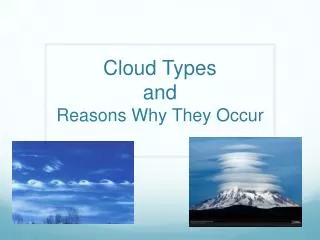
Other Cloud Formations • These clouds do not fit into the typical classifications mentioned in the previous slides. • The causes of these clouds vary greatly. • Examples: • Contrails – created by air planes. • Billow Clouds (wave clouds) – created by instability. • Mammatus – created by sinking motions. • Pileus Clouds (capping clouds) – created when air is forced upward and cooled. Usually associated with convection but can be seen covering mountain tops. • Lenticular Clouds – created when air is forced upward by orographic barriers.
Contrails Billow Clouds Mammatus Pileus Clouds Lenticular Clouds
Exercise: Name That Cloud _____________________ ____________________ ____________________ Hint: Look at the base _____________________ ____________________ ____________________ Hint: This is a mid level cloud