Advanced Adversarial Search in Game Theory: Minimax and Alpha-Beta Algorithms Explained
This chapter delves into adversarial search within game theory, focusing on two-person games with perfect information, such as chess and checkers. We explore algorithms like Minimax for optimal decision-making in these games, contrasting it with multi-person games and those with imperfect information, like poker and card games. The Alpha-Beta pruning algorithm is discussed as an efficient enhancement to Minimax, improving search depth and speed. By examining various game types and search strategies, this chapter provides insight into computational techniques used in game-playing AI.

Advanced Adversarial Search in Game Theory: Minimax and Alpha-Beta Algorithms Explained
E N D
Presentation Transcript
Game-Playing Read Chapter 6 Adversarial Search
State-Space Model Modified • States the same • Operators depend on whose turn • Goal: As before: win or win amount • Search: somewhat different
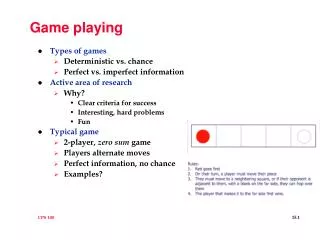
Game Types • Two-person games vs multi-person • chess vs monopoly vs poker • Perfect Information vs Imperfect • checkers vs card games • Deterministic vs Non-deterministic • go vs backgammon
Simplest First:Two-Person Games: Perfect Information • BF = branching factor (average) • Chess: BF ~36 • expert level • Checkers: BF ~ 8, world champion • Othello: BF ~10, better world champion • Go: BF ~200 • $2 million prize
MiniMax Algorithm (perfect information, 2 person game) • Assume: evaluation of terminal position • Win = +1, Loss = -1, Draw = 0. • Descendants of max node is min node, etc. • Algorithm: recursive • Value Max Node = max(descendants of node) • Value Min Node = min(descendants of node) • Value of terminal node: by evaluation function • Applies to any tree with values assigned to leaves. • NOTE: If tree to end of game, guaranteed best move, else no one knows.
Optimal Play • Make move that yields highest minimax score. • Computation: search: depth-first • Time = b^d • Memory= b*d
Applied to Chess • Average game is 40+ moves • Tree to large to reach terminal positions • Static board evaluation of worthiness • Uses Partial Tree • MiniMax yields optimal value for restricted tree, with values assigned by evaluation. • No theorems connecting valuation on partial tree to estimates for complete tree.
Alpha-Beta Algorithm • Yields exactly same value as minimax • Knuth analyzed: time or nodes = O(b^d/2) • Doubles depth of search with same time. • Constant depends on ordering of nodes • Iterative deepening alpha/beta achieves better ordering. (reorder after depth)
Alpha-beta Algorithm • Each node is assigned a range of values: [alpha,beta]. The real value will lie between. • The root is assigned [-inf,+inf]. • For any max node N with values [A,B] • if a son has value >=C, then N has new range [C,B]. • If interval is empty, all nodes below cut. • For any min node N with values [A,B] • if son has value <=D, then N updated to [A,D]. • Formal code in text. • http://www.cs.mcgill.ca/~cs251/OldCourses/1997/topic11/ • http://www.ocf.berkeley.edu/~yosenl/extras/alphabeta/alphabeta.html Applet illustration
Multi-player Games • Extension of minimax • assign a vector of values to each position • vector has value relative to each player • Each player maximizes choice • Equals minimax for 2 person game • No variations like alpha-beta
Games with Uncertainty • Card games like hearts or bridge • Backgammon (roles of dice) • Expectimax • Does it work? • Theoretically nice, but where’s the meat – for what games was it successful?
Certainty from Uncertainty • Simulation • Replace unknown world by specific world • simulate (or use alpha-beta) • Each simulation yields a play • Vote • Works for hearts and bridge play • bridge high level card play can’t make information gathering plans
What about War • Games are games – restricted uncertainty • What are the operators in war? • unknown effects • unknown number • What is the state? • unknown