Understanding the Basics of Organic Chemistry: Carbon, Molecules, and Macromolecules
130 likes | 245 Vues
Dive into the essential concepts of organic chemistry, centered around carbon's unique bonding capabilities. Explore how carbon forms strong covalent bonds with oxygen, hydrogen, sulfur, and nitrogen—creating diverse molecules like H2O and NaCl. Learn about key vocabulary terms such as molecules, monomers, polymers, and macromolecules, alongside examples like glucose and DNA. Discover the four main categories of macromolecules: carbohydrates, lipids, proteins, and nucleic acids, each with distinct structures and functions in living organisms.


Understanding the Basics of Organic Chemistry: Carbon, Molecules, and Macromolecules
E N D
Presentation Transcript
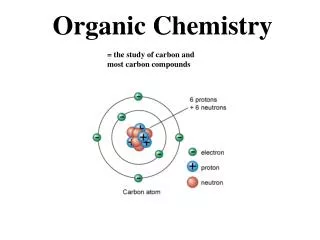
Organic Chemistry • All about CARBON!!!! • 4 electrons available and ready to bond • Carbon also likes to bond with other Carbon • this makes carbon chains!
Organic Chemistry • Forms strong bonds (covalent) with • Oxygen (2) • Hydrogen (1) • Sulfur (3) • Nitrogen (3) • Because Carbon is so versatile and strong it is often called a “carbon backbone” • Two or more atoms make a molecule • H2O • NaCl
Organic Chemistry • Vocab: • Molecule: when two or more atoms bond • Ex: H2O & NaCl • Monomer: small groups of molecules that bond with other groups of molecules • Ex: Glucose & Fructose • Polymer: Several monomers bonded together • Ex: Starch & DNA • Macromolecule: several polymers bonded together • Ex: Carbohydrates & Lipids • Images from the following websites: • MOLECULE: (http://www.materialssciencerocks.com/hydrogen-bonding-what-holds-everything-together/ ) • Monomer(http://www.google.com/imgres?imgurl=&imgrefurl=http%3A%2F%2Fmoodle.esu13.org%2Fmod%2Fassignment%2Fview.php%3Fid%3D51639&h=0&w=0&tbnid=4YNbW_nCENZSzM&zoom=1&tbnh=192&tbnw=262&docid=mwlIO-E0II8TiM&tbm=isch&ei=ecMkVLGgB5KZyATB0IDICg&ved=0CAQQsCUoAA ) • Polymer (http://pslc.ws/macrog/kidsmac/basics.htm ) • Macromolecule (http://galleryhip.com/dna-macromolecule.html )
Organic Chemistry Four Main Categories • Carbohydrates • Lipids • Proteins • Nucleic Acids Image from: http://www.haspi.org/curriculum-library/Med-Bio-Core-Labs/00%20NEW%20NGSS%20Med%20Bio%20Labs%20COMPLETE/07%20Teacher%20-%20Macromolecules.pdf
Carbohydrates • Made of: • Carbon • Hydrogen • Oxygen • Monomer: monosaccharide • Ex: Glucose & Fructose • Polymer: Polysaccharide • Ex: Starch • Functions: easy/short term energy storage • Image from: http://www.todayifoundout.com/index.php/2010/11/misconceptions-surrounding-carbohydrates/
Lipids • Made of: • Carbon • Hydrogen • Oxygen • Monomer: Glycerol & Fatty Acids • Functions: long term energy storage, cell structure and cell-to-cell communication • Image from: http://chemistrypictures.org/index.php/lipids
Lipids • Energy Storage • Ex: Fats & Oils • Lots of potential energy in the fatty acid tails • Long-term energy storage, but harder to break down than carbs • Image from: http://weloveteaching.com/0bio105/lectures/organics/Lipids.jpg
Lipids • Nonpolar (don’t dissolve in water) • Cell Structure: • Phospholipids • Hydrophilic (water loving) head • Hydrophobic tail (water fearing) • Creates a bilayer cell membranes!!! • Image from: http://upload.wikimedia.org/wikipedia/commons/thumb/3/39/Phospholipid_TvanBrussel.jpg/300px-Phospholipid_TvanBrussel.jpg
Lipids • Cell-to-cell communication Steroids!! • Cholesterol • Response to stress • Ring shaped • Image from: • Cholesterol: http://elitemensguide.com/emg-health-numbers-hdl-cholesterol-and-ldl-cholesterol/ • Steroid structure https://encrypted-tbn3.gstatic.com/images?q=tbn:ANd9GcSQ7POqWcDhvCcJ0j4QNEbSJabO-zHEqZkCcyVr5jqLHXlPrfqC
Proteins • Made of: • Carbon • Hydrogen • Oxygen • Nitrogen • Monomer: Amino Acids • Polymer: Proteins • Functions: Cell regulation, control rate of reaction, and helping build bone & muscle • Images from: • Structure http://amit1b.wordpress.com/the-molecules-of-life/about/ • Food: http://livehealthyosu.com/tag/caffeine/
Nucleic Acids • Made of: • Carbon • Hydrogen • Oxygen • Nitrogen • Phosphorous • Monomer: Nucleotide • Polymer: DNA & RNA!!! • Image from: http://images.tutorvista.com/cms/images/81/dna-and-rna.png
Nucleic Acids • Function: Store and transmitting (passing on) genetic information! • Image from: http://www.visualphotos.com/photo/1x6057874/human_baby_dna_helix__genetic_sequences_artwork_g340052.jpg