Strategies for Effective Climate Change Adaptation: Insights from the Southeast and Caribbean
210 likes | 312 Vues
This outline explores various tactics for facilitating climate adaptation, focusing on both top-down and bottom-up planning approaches. It identifies barriers to effective adaptation and presents strategies like adaptive management and mainstreaming climate considerations into existing processes. Key insights include understanding stakeholder priorities, employing no-regrets strategies, and utilizing tools such as risk analysis and scenario exercises to enhance stakeholder engagement. The document emphasizes the importance of making climate change relevant to local management concerns to encourage proactive adaptation efforts.


Strategies for Effective Climate Change Adaptation: Insights from the Southeast and Caribbean
E N D
Presentation Transcript
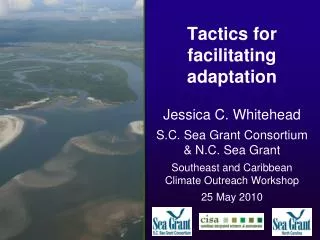
Tactics for facilitating adaptation Jessica C. Whitehead S.C. Sea Grant Consortium & N.C. Sea Grant Southeast and Caribbean Climate Outreach Workshop 25 May 2010
Outline • Barriers to adaptation planning • Top-down and bottom-up planning approaches • Accessible planning strategies in action • Adaptive management • Mainstreaming • “No regrets” and “minimal regrets” strategies • Useful tools and activities for facilitating adaptation
Reasons for reluctance on adaptation: • Current observed changes at local, regional scales not yet directly attributable to climate change • No documentation of current adaptation effects in reducing directly attributable impacts • Impacts and vulnerabilities diverse in time, space • Relatively little research on climate change adaptation actions NRC 2010
NRC Risk Management Approach NRC 2010
TOP-DOWN Climate scenario-driven Vulnerability from impacts Infer adaptation options Focus on what to do BOTTOM-UP Community needs-driven Vulnerability from community conditions Identify adaptive capacities, processes Focus on what can be done “Top-down” and “bottom-up” adaptation planning Smit and Wandel 2006
TOP-DOWN Hydrologic model Climate scenarios force hydrologic model Determine drinking water system impacts Adaptation benefits-costs BOTTOM-UP Water system & community characteristics Exposure scenarios Socioeconomic scenarios Water system adaptive capacity Example: Salt water intrusion & water supply
Identify decision-makers and stakeholders • Stakeholder interactions affect decisions • Differing priorities • “Ripple effect” • Methods • Key informant interviews • Social network analysis Whitehead 2009
Making climate change relevant • Describe uncertain RISK to communities • Explain broader implications than just higher temperatures or inundation • Today’s risks change frequency/severity • Many are risks stakeholders already manage • Preparation saves money, time!
Planning for Climate Change Adaptation • Separate planning process • Punta Gorda, FL • Keene, NH • King County, WA • State of Maryland • Integrate into current planning processes • Poquoson, VA • Onslow County, NC
Making response accessible • Climate change may not be tipping point for action • Adaptive management: systematic cycle of implementation, assessment, readjustment • Mainstreaming: incorporate planning into existing decision-making processes and structures • “No regrets” or “minimal regrets” strategies Smit and Wandel 2006
Adaptive management • Adaptation is a learning process! • Systematic cycle of implementation, assessment, readjustment Adapted from Berkhout et al. 2004, Pahl-Wostl 2002
Mainstreaming and “no regrets” • Mainstreaming • Recognizes climate change unlikely tipping point for action • Incorporates adaptation into existing decision-making processes and structures • “No regrets” or “minimal regrets” • Seeks actions that will reduce vulnerability to immediate stressors AND climate change • Provides more motivation to pay the price Smit and Wandel 2006
Mainstreaming SLR into current planning processes • Zoning • Building codes • Stormwater management • Water & sewer • Land use • Economic development
Floor joist elevation Surviving houses (◊) Wave damaged houses Destroyed Houses Minimal regrets: Freeboard vs. failure on Bolivar Peninsula, TX during Hurricane Ike Courtesy of Spencer Rogers, NC Sea Grant
Useful tools and activities for facilitating adaptation • Assessment guides • Concept mapping • Causal pathways • Risk analysis • Group model building • Scenario exercises (Whitehead 2009)
Key steps • Identify stakeholders and decision-makers & their readiness for information and action • Make climate change relevant to management concerns • Choose strategies & make them accessible • Top down vs. bottom up • Separate vs. integrated planning process • Adaptive management, mainstreaming, no/minimal regrets
Jessica WhiteheadRegional Climate Extension Specialistc/o South Carolina Sea Grant Consortium287 Meeting St.Charleston, SC 29401O (843) 953-2090M (843) 693-1506jessica.whitehead@scseagrant.org
References • National Academies of Science. 2010. Adapting to the Impacts of Climate Change. Washington, D.C.: The National Academies Press. 244 p. • Parry, M.L., O.F. Canziani, J.P. Palutikof, P.J. van der Linden and C.E. Hanson, Eds. 2007. Contribution of Working Group II to the Fourth Assessment Report of the Intergovernmental Panel on Climate Change.Cambridge, UK:Cambridge University Press, 976 p. • Smit, B., and J. Wandel. 2006. Adaptation, adaptive capacity, and vulnerability. Global Environmental Change16: 282-92. • Whitehead, J.C. 2009. Building Scenarios of Adaptive Capacity: Case Studies of Community Water Systems in Central Pennsylvania. PhD. Dissertation in Geography, The Pennsylvania State University, University Park. eTD available: http://etda.libraries.psu.edu/theses/approved/WorldWideIndex/ETD-4140/index.html