Constructing a Compass Device to Measure Earth’s Magnetic Field
This project details the construction of a device utilizing a compass needle to measure the Earth's magnetic field. It covers the theoretical background including the importance of Earth's magnetic field, the Van Allen Belt, and methods of measurement using magnetic needle deviation and a rotating coil. Experimentation involves a DC source, rheostat, and data acquisition of current and deflection angles. Results are analyzed through linear regression to determine the final value of the Earth's magnetic field. The paper also discusses potential sources of error and compares experimental findings to theoretical predictions.

Constructing a Compass Device to Measure Earth’s Magnetic Field
E N D
Presentation Transcript
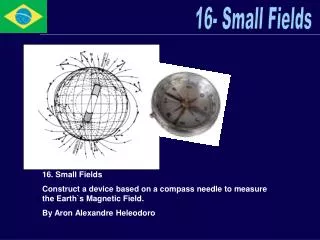
16- Small Fields 16. Small Fields Construct a device based on a compass needle to measure the Earth`s Magnetic Field. By Aron Alexandre Heleodoro
16- Small Fields Introduction • The importance • Superficial • Exterior Field (Van Allen Belt) • How to measure it • Using the magnetic needle deviation • Using the charge deviation • Using a rotating coil
16- Small Fields The Method • Mathematical Model • Vectorial sum of two fields • #1: Earth’s Magnetic Field • #2: A field of known intensity and direction • Biot-Savart Law • Intensity and direction the magnetic field in a coil • Linear relation between the current in a coil and the tangent of the deflection angle. • Practice • Electric Circuit • Data acquisition (current and deflection angle) • Linear regression • Final value of the Earth’s magnetic field
16- Small Fields The Method
I q 16- Small Fields Development - Theory • Deviation • Biot-Savart Law • Linear Relation • Inclination • Total Field
16- Small Fields Development - Experiment 1 DC source 0-12V 1 rheostat 1 coil with 90 turns 1 ampere meter 1 magnetic needle • Materials • Set up • CollectedData
16- Small Fields Development - Experiment • Photos • Video
16- Small Fields Development - Data Analysis • Tables • Graphics • Final Result
16- Small Fields Experiment - Error Sources • Other Magnetic Sources and interference in the Net Field • The Geometry of the model • Magnetic needle is an extensive body • Geometric center of the coil • Imprecisions in the measurement of the angle and current • Friction in the magnetic needle • Parallaxes
16- Small Fields Conclusion • Comparison with a theoretical value • Good theoretical model