Download
1 / 15
150 likes | 277 Vues
This resource aims to enhance our understanding of leaf anatomy, focusing on the epidermis, stoma, and mesophyll layers. The epidermis serves as a protective outer layer of cells, facilitating gas exchange through stomata while regulating water loss. The mesophyll, consisting of the palisade and spongy layers, plays a crucial role in photosynthesis, housing chloroplasts. This guide contrasts leaf functions with animal responses to environmental changes, emphasizing the importance of water regulation and food production. Perfect for students preparing for the Regents practice test.

E N D
Objective – To continue our learning about the leaf • Warm Up • Put your leaf lab in the center of the table • What are smart things to do while taking an exam Reminder – today is the regents practice test
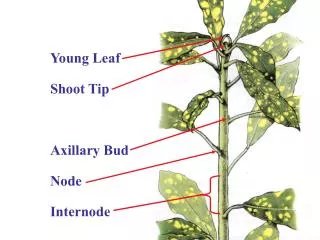
Epidermis • Out layer of cells covering the leaf • Boundary with the outside world • Often transparent (no chloroplasts – allows light through to photosynthesizing cells) • Often covered with a waxy coat (sometimes reduced on the underside) • Functions: • Protection against water loss • Regulation of gas exchange (has openings call stoma or stomata – plural = stomates) • Secretion of metabolic compounds • In some species it may help in water absorption
Stoma – (Opening and Guard Cells) • Openings in the leaf surface • Zone of gas exchange (Carbon Dioxide, Oxygen and Water) • Bordered by Guard Cells • Specialized cell that respond to the environment to control gas exchange • Especially sensitive to water conditions and regulating water loss. (They close to prevent the greatest amount of water loss. Especially important in succulents that grow in arid environments.)
Mesophyll • Palisade Layer • Generally cells are very close • Most concentrated chloroplasts • Site of Photosynthesis • Spongy Layer • More space exists between cells (for air) • Cells contain chloroplasts • Site of Photosynthesis • Veins run through this layer of cells
Comparison Plant Animal (Human) Protection Regulated exchange with the environment Responds to the environment (goose bumps, etc.) No food production • Protection • Regulated exchange with the environment • Responds to the environment (guard cells especially) • Region of primary food production