
Copy table into your notebook
E N D
Presentation Transcript
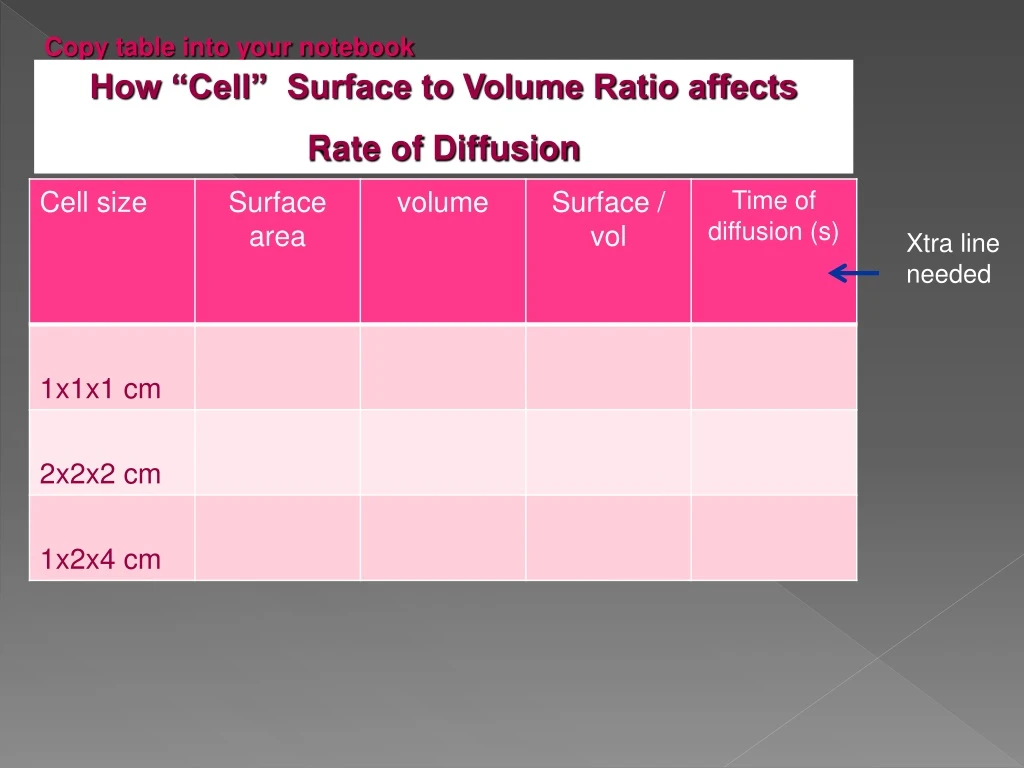
Copy table into your notebook How “Cell” Surface to Volume Ratio affects Rate of Diffusion Xtra line needed
Cell size Limits • The cell must be • large enough to hold materials it needs • small enough to be controlled by the genetic material • ***have large enough surface to volume ratio to allow for efficient exchange of materials with environment at a rate fast enough to sustain life • Most cells are between 10- 20um Nutrients Waste
Each side 1cm x1cm = 1cm2 / side X 6 sides 6cm2
Volume = 1 cm x 1 cm x 1 cm = 1 cm 3 Sfc/vol = 6:1 6:1 6cm2 1 cm 3
Complete chart for other 2 sizes 6cm2 6:1 1 cm 3 24cm2 3:1 8cm 3 28cm2 8cm 3 3.5 : 1 1cm x 2cm x 2 sides = 4cm2 1cm x 4 cm x 2 sides = 8cm2 2cm x 4 cm x 2 sides = 16cm2
In general cells are rarely larger than 20 um. But not always, Can U think of a cell type that can be over a meter long? How could an organism increase its size wo decreasing efficiency?
Surface: volume ratio can be increased by • Altering cell shape: elongating ex. Microvilli, alveolar epithelium
Surface: volume ratio can be increased by • Altering cell shape: elongating , foldsx. Microvilli, alveolar epithelium • Cell ÷ creating more cells w/ same total vol. ex multicellular organism ppt3