Download
1 / 11
110 likes | 227 Vues
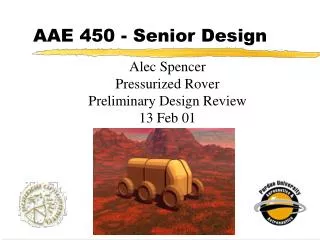
This document outlines the preliminary design review for a Long-Range Pressurized Rover by Alec Spencer. The rover is intended for long-term exploration missions on Mars, focusing on scientific scouting, geological surveys, and water table mapping. Key design specifications include a range of over 1000 km, crew capacity for two (with emergency provisions for four), and operational duration of up to 10 days. Features such as redundant systems for propulsion, power, and habitat support ensure mission safety. The rover’s advanced capabilities include remote control, sonar mapping, and automated meteorological studies.

E N D
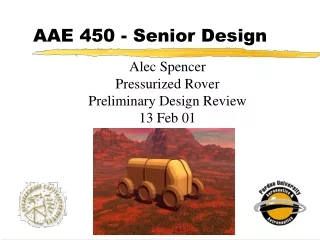
AAE 450 - Senior Design Alec Spencer Pressurized Rover Preliminary Design Review 13 Feb 01
Science • Long Range Exploration Strategy • Long Range Pressurized Rover • Capabilities • Redundancy • Greenhouse Concepts
Long Range Exploration • Initially focus on scouting (6 months) • Scout geology • Chart water table • Focus on key sites (6 months) • Scientist discretion
Rover Capabilities • Design Specifications • Range: 1000+ km • Crew: 2 (4 in emergency) • Duration: 10 days (30 in emergency)
Rover Capabilities • Clearance: 0.85 m • Maximum speed: 40 kph • Maximum slope: 60o * • Maximum side-hill angle: 45o • Turning radius: 10 m
Features • Control • Joystick • Modular Electronic design • Remote control capabilities • Science • Meteorology (autonomous) • Sonar or radar mapping (autonomous) • Drilling or core samples
Features • External roll cage • 4 x 6 drive • 3 computer stations • Shower and chemical toilet
System Redundancy • Propulsion • Main methanol engine • Methanol and O2 diesel cycle • CO2 buffer • Main source of heating • Electric • Emergency power to return to HAB • Acts as generator when not in use
System Redundancy • Power systems • Generator powered by engine • Electric engine as generator • (Fuel Cell) • Batteries
System Redundancy • Airlock • Emergency shelter in case of hull breach • Doubles as toilet and shower • Suit design
Greenhouse • Weight • Lightweight if inflatable • Shielding • UV levels too high for plant life • Shielding for a large structure would be prohibitive