Understanding Coral Reefs: Types, Requirements, and Biodiversity
Dive into the fascinating world of coral reefs, exploring their types including fringing, barrier, atoll, and patch reefs. Learn the essential requirements for reef existence such as 3-D topography, biological mediation, and environmental factors. Discover the diverse communities supported by these ecosystems, including the organisms that build, bind, and baffle. Understand the delicate balance of reef environments and the impacts of global changes, highlighting the need for conservation. Join us on a journey through the geological history and present-day significance of coral reefs.

Understanding Coral Reefs: Types, Requirements, and Biodiversity
E N D
Presentation Transcript
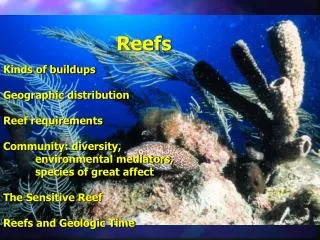
Reefs Kinds of buildups Geographic distribution Reef requirements Community: diversity, environmental mediators, species of great affect The Sensitive Reef Reefs and Geologic Time
Reef requirements: 1. Coral reefs are rigid structures above the sea floor. Keep up with sea level or drown 2. Biologically mediated 3. Structure and environemtn
Reef requirements: 1. 3-D topography 2. Biological Origins and Mediation Created by organisms Organisms baffle, bind, accrete modify environment 3. Structure and Environment
Reef requirements: 1. 3-D topography 2. Biologically mediated 3. A complex ecological and physical structure that exerts control on the environmet
Types of Reefs: Fringe Edge of landmass Continents, islands High energy from waves Small lagoon, if any
Types of Reefs: Barrier “Mature” fringe reef without landmass Kept up with sea level rise appears far away from shore Large, ecologically rich lagoon between reef and land
Types of Reefs: Atoll Also formed from fringe reefs Ring structure from sunken island (subsidence or sea level rise) Reef with internal lagoon, no land mass
Types of Reefs: Patch Often in lagoon behind barrier, atoll Low energy environment Differentiated from surrounding biota by: 3-D topography Biological mediation Structure and environment
Types of Reefs: Manmade Accidental… (industry, pollutants, wrecks) …Or intentional
Tropical reef requirements High light intensity: very low turbidity zooxanthellae in symbiosis with corals Warm T: between 20-30C Constant salinity Nutrients: upwelling, other input BUT: nutrient poor waters in reef Very tightly recycled Constant currents
Communities 1 Very diverse, highest diversity community in the world Climax community High degree of niche specialization Resources very finely partitioned
Guilds that Mediate Environment Bafflers: corals, sponges
Guilds that Mediate Environment Bafflers: corals, sponges Binders: microbes, coralline algae, bryozoans
Guilds that Mediate Environment Bafflers: corals, sponges Binders: microbes, coralline algae, bryozoans Builders: corals
Guilds that Mediate Environment Bafflers: corals, sponges Binders: microbes, coralline algae, bryozoans Builders: corals Eroders: parrot fish, echinoids
Communities 2 Recruitment between reefs and within a reef Indo-Pacific reefs: highest diversity “Oldest” reef? Leftover from Tethys?
The Fragile Reef Reefs in very fragile balance Algae overgrowth and echinoids, other grazers Specialists: higher extinction possibility Interactions fairly tight Species of great effect, keystone species Physical factors: Sea-level rise T and global warming Nutrient input and algal blooms Saharan dust and fungus
Geologic History of Reefs Earliest buildups: Precambrian stromatolites Early Cambrian: Archaeocyathid reefs: 500MY Devonian: Tabulate, rugosa coral reefs Permian: Capitan sponge reef in TX Cretaceous: Various Cenozoic: coral reefs