Historical Review of Educational Computing
120 likes | 250 Vues
This comprehensive review by Dr. Nancy P. Hunt outlines the evolution of educational computing from the 1960s to the 1990s. It traces the journey from early mainframe systems and the introduction of the Apple I and II in classrooms to the rise of powerful 128K machines in the mid-80s. The 1990s marked a revolution with the Macintosh's graphical user interface, the emergence of hypermedia applications like HyperCard, and the implications of CD-ROM and internet technologies. The analysis highlights curriculum shifts towards problem-solving and collaborative learning driven by technological advances.


Historical Review of Educational Computing
E N D
Presentation Transcript
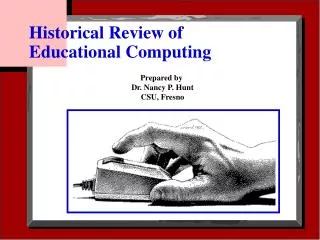
Historical Review of Educational Computing Prepared by Dr. Nancy P. Hunt CSU, Fresno
I. The Early Years • 1960's -- mainframe computing • 1976 -- Apple I • Developed at the Homebrew Computer Club in Palo Alto • 1977 -- Apple II debuted in classrooms • 1980 -- "flood" of computers in schools: • Apple II, Commodore PET, Texas Instruments 99, Atari, Radio Shack TRS-80 (IBM introduced first PC's in 1981)
Characteristics of Early Years • A. Typical hardware: TV set & cassette tapes • B. Applications: • programming (in BASIC, later Logo & Pascal) • drill/practice programs
II. The Middle Ages (mid-80's) • A. Development of first 128K machines • Apple IIe, PC jr. • B. More powerful machines allowed the development of applications software • The Print Shop, AppleWorks,Visicalc & Wordstar • C. “Talking" software for Tandy & Apple IIGS. • D. Development of ILS's -- networked curriculum • Computer Curriculum Corporation (CCC), WICAT, Jostens
III. The Renaissance -- New Beginnings/ New Decade (1990's) • A. Macintosh -- Graphic User Interface • B. HyperCard -- first hypermedia program • B. Hypermedia available on all platforms • C. Widespread adoption of CD-Rom technologies • D. Telecommunications capabilities • Internet • World Wide Web
IV. Evolution of Computer Curricula • A. Programming & Computer Literacy • vocational necessity • “trains the mind”
IV. Evolution of Computer Curricula • B. Computer Tool Curriculum • wordprocessing, database, spreadsheets, graphics, telecommunications • problem: must include content/context
IV. Evolution of Computer Curricula • C. Problem Solving Curriculum • Logo • “Problem solving” software
IV. Evolution of Computer Curricula • D. Curriculum-Specific Tools • Language Arts • Mathematics • Social and Natural Sciences • Arts
IV. Evolution of Computer Curricula • D. Hypermedia Programming • HyperCard (Macintosh) • HyperStudio (Apple IIgs, now also for Mac) • Toolbook and Linkway (MS-DOS)
IV. Evolution of Computer Curricula • D. Telecommunications • Electronic mail • Bulletin boards • Newsgroups & listservs • Remote access -- databases and files • Video conferencing
IV. Strongest Trends • Away from drill and practice, with an emphasis on basic skills acquisition Towards promoting collaborative, active learning projects which require critical thinking skills and complex understandings. • Increased use of multimedia and telecommunications