Metadata Standards
Metadata Standards. Catherine Lai MUMT-611 MIR January 27, 2005. Presentation Outline. Definition of Metadata Functions of Metadata Types of Metadata Examples of Metadata Standards Conclusion and Outstanding Questions Questions and Comments. Defining Metadata.

Metadata Standards
E N D
Presentation Transcript
Metadata Standards Catherine Lai MUMT-611 MIR January 27, 2005
Presentation Outline • Definition of Metadata • Functions of Metadata • Types of Metadata • Examples of Metadata Standards • Conclusion and Outstanding Questions • Questions and Comments
Defining Metadata • Structured data about data • To identify, arrange, describe, and enhance access to an information object (screen shot of a partial Muse bibliographic record) • Data describing digital resources
Functions of Metadata • To describe the record content • what object contains or is about • To document the record context • who, what, why, where, how of creation • To preserve record’s structure • formal set of associations • To provide intellectual access points for users • To provide information in a physical reference
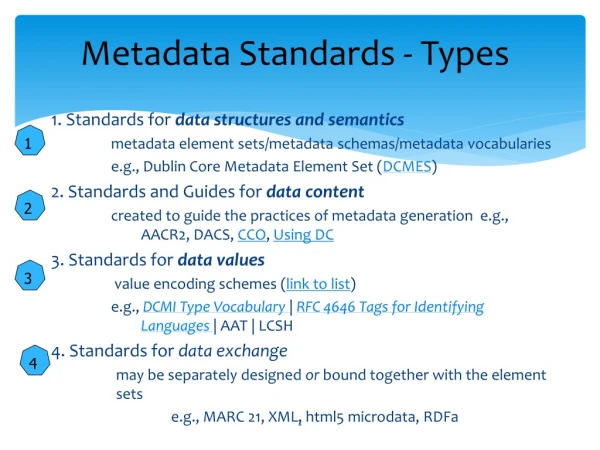
Examples of Metadata Standards • MAchine-Readable Cataloging (MARC) • Dublin Core (DC) • Text Encoding Initiative (TEI) • Encoded Archival Description (EAD) • Visual Resource Association Core Categories (VRA Core) • Metadata Object Description Schema (MODS) • Many others
MARC • Originated in 1966 • MAchine Readable Catalog • First comprehensive computerized metadata scheme • MARC --> USMARC & CAN/MARC (1980s) --> MARC 21 (1997) • Metadata standard for library catalogs • Maintained by the Network Development and MARC Standards Office at LC and the Standards and the Support Office at the National Library of Canada
Example of a MARC Record Fixed fields --> (Leader) -------------- computer generated index (Directory) -------------- Variable fields --> • Tag (3-digit number) • Indicator (1-digit number) • Subfield (preceded by the delimiter e.g. ‡n) (http://www.music.indiana.edu/tech_s/manuals/training/marc/record1.html)
MARC Tag Group • Numerically by function: (http://www.oclc.org/bibformats/en/default.shtm)
Example of a MARC Record (http://www.oclc.org/bibformats/en/default.shtm)
Dublin Core • Developed in 1995 for web resources • Set of 15 simple elements: Title Description Source Creator Type Relation Subject Format Language Publisher Identifier Coverage Contributor Date Rights • Support resource discovery (IR) on the web • General and Easy • Main usage currently embedded into HTML meta tags
Example of Dublin Core <HTML> <HEAD> <TITLE>A Poem</TITLE> <META NAME="DC.Title" CONTENT=”A Poem"> <META NAME="DC.Creator" CONTENT=”Lai, Catherine"> <META NAME="DC.Type" CONTENT="text"> <META NAME="DC.Date" CONTENT=”2005"> <META NAME="DC.Format" CONTENT="text/html"> <META NAME="DC.Identifier” CONTENT="http://www.music.mcgill.ca/~lai/poem.html"> </HEAD> <BODY><PRE> A poem line 1 A poem line 2. A poem line 3 A poem line 4.</PRE></BODY> </HTML>
TEI • Launched in 1987 • Guidelines for encoding machine-readable texts to the humanities and social sciences • “maximally expressive and minimally obsolescent” (www.tei-c.org) • Document structural hierarchy, divisions, and characteristic tags
Example of TEI Markup <p><q>She'll happen do better for him nor ony o' t' grand ladies.</q> And again, <q>If she ben't one o' th’ handsomest, she's noan faàl, and varry good-natured; and i' his een she's fair beautiful, onybody may see that.</q></p> <p>I wrote to Moor House and to Cambridge immediately, to say what I had done: fully explaining also why I had thus acted. Diana and </p> (http://www.tei-c.org/Lite/U5-eg.html)
Example of TEI Markup <p>I wrote to Moor House and to Cambridge immediately, to say what I had done: fully explaining also why I had thus acted. Diana and <pb n='475'/> Mary approved the step unreservedly. Diana announced that she would just give me time to get over the honeymoon, and then she would come and see me.</p> (http://www.tei-c.org/Lite/U5-eg.html)
Conclusion and Outstanding Questions • Little consensus on level of complexity of semantic structure • Need flexibility and scalability • Different disciplines for different formats • Need interoperability and accessibility