Download
1 / 14
140 likes | 245 Vues
A city is defined as a large, permanent settlement, distinct from a town by specific legal and administrative criteria. Cities are characterized by their complex systems for sanitation, transportation, and utilities, prioritizing citizens' needs. They offer essential services like water and safety, alongside quality of life features such as parks and libraries. Economic growth is vital, typically supported by various industries, agriculture, and commercial areas. City planning may adapt to natural geography or prioritize structured development for citizen well-being and economic success.

E N D
What is a city • A city is a relatively large and permanent settlement. • Although there is no agreement on how a city is distinguished from a town within general English language meanings, many cities have a particular administrative, legal, or historical status based on local law.
Example: • For example, in the U.S. state of Massachusetts an article of incorporation approved by the local state legislature distinguishes a city government from a town. • In the United Kingdom and parts of the Commonwealth of Nations, a city is traditionally a settlement with a royal charter. • Historically, in Europe, a city was understood to be an urban settlement with a cathedral. • Cities generally have complex systems for sanitation, utilities, land usage, housing, and transportation.
Prioritizing the needs of citizens • basic city services required for sustaining life and keeping people safe are: • water, sewer, power, safety (fire and police) • transportation systems that provide access to the other necessities including places of employment, medical services (hospitals, clinics, and doctors), food (commercial areas), and education (universities and schools). • .
Other City Features less essential • BUT necessary for quality of life include: • public parks • recreational facilities • Libraries • sports facilities • places for religious worship • museums.
Other Basic Services • Basic to the economy of cities¾as well as providing some necessities are: • Commercial areas like stores, malls, and restaurants.
Economic Growth Necessary • All cities need a basis for economic growth and sustenance, and, depending on location, that economy may be based on any combination of the following: industry (factories and high-tech businesses), agriculture, entertainment, and tourism
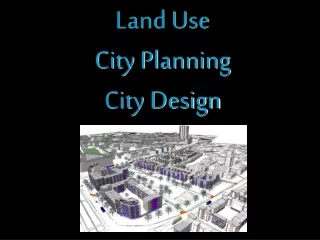
Placement of city features • City features are arranged within an area of land in a large variety of ways. • Some of these arrangements begin to exist as a city grows based on need and the restrictions within the natural geography of the area where the city is located. (my area new, need Publix, need school, library, fire station) • Some cities are in part or entirely planned for maximum impact on the quality of life for citizens and economic growth. (Cancun) (punta Cana)
Links to maps • http://www.bing.com/maps/Default.aspx?encType=1&v=2&ss=ypid.YN10001x403201786&style=r&mkt=en-us&FORM=LLDP#Y3A9MTguNDMxNjU1fi02OS40MDc4MDImbHZsPTE1JnN0eT1o • http://maps.google.com/maps?hl=en&bav=on.2,or.r_gc.r_pw.&biw=1000&bih=815&wrapid=tlif134565165975611&q=cancun&um=1&ie=UTF-8&hq=&hnear=0x8f4c2b05aef653db:0xce32b73c625fcd8a,Canc%C3%BAn,+Quintana+Roo,+Mexico&gl=us&sa=X&ei=ywM1UNmpLcbx0gGy84GgBA&ved=0CKsBELYD
Types of Building • Residential • Commercial • Industrial • Muncipal
Industrial Buildings • Any property that's used to produce an income -- as opposed to being used as living quarters -- is considered to be a commercial one. • Industrial property is used for manufacturing some kind of product and can be seen as a factory of plant. • Usually it's in an area that's zoned for light, medium, or heavy industrial purposes.
Commercial Building • In contrast to industrial, a commercially zoned property will be involved in selling merchandise of one kind or another or in providing a service of some sort. • Walmart • Pizza Shop
Municipal Property Controlled by state or government Courthouse Townhall Police/Fire station Parks and Rec.
Residential • A residential area is a land use in which housing predominates, as opposed to industrial and commercial areas. • Housing may vary significantly between, and through, residential areas. These include single family housing, multi-family residential, or mobile homes. • Where people Live