Download

1 / 19
190 likes | 310 Vues
This chapter provides an essential overview of fundamental geometric concepts including points, lines, planes, and angles. Readers will learn definitions and properties of key terms such as collinear, coplanar, segments, rays, and various types of angles (acute, obtuse, right, complementary, and supplementary). The chapter also introduces postulates regarding intersections, congruence, and the addition of angles and segments. Engage with practice problems to solidify your understanding of these concepts.

E N D
Chapter 1.1-1.3 By Skyler Cassity & Ryan Tourial
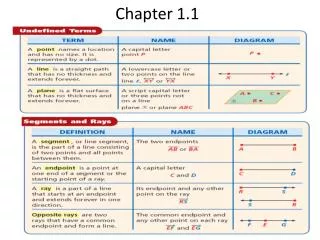
Vocabulary • Point- geometric points that have no size, usually depicted as a dot. • Lines- geometric line has no thickness, is perfectly straight, and extends forever. • Planes- geometric plane extends infinitely in all directions along a flat surface. • Collinear- points that are all contained on a single line.
Vocabulary • Coplanar- points that are all contained in a single plane • Segment- part of a line that begins at one point and ends at another • Endpoints- the points that end the segment • Ray- part of a line that starts at a point and extends infinitely in one direction
Vocabulary • Endpoint- the end of one side of the ray • Angle- figure formed by two rays with a common endpoint • Vertex of the Angle- The common endpoint of the two rays in an angle • Sides of the Angle- the rays in an angle • Interior of an Angle- the area inside of the angle
Vocabulary • Exterior of an Angle- the area outside of the angle • Intersect- when geometric figures have on or more points in common • Intersection- the set of points that they have in common • Postulates- fundamental geometry ideas involving intersections of geometric figures
Vocabulary • Number Line- line that has been set up to correspond with real numbers • Coordinate of a Point- a point on a number line that is always a real number • Length- the measure between points on a number line l a-b l or l b-a l • Unit Length- a distance between something in measurements
Vocabulary • Congruent- figures that are the same shape and size • Degree- the most common unit for measuring angles • Complementary angles- are two angles whose measure have a sum of 90 degrees.
Vocabulary • Supplementary Angles- two angles whose measures have a sum of 180 degrees. • Right Angles- angle whose measure is 90 degrees • Acute Angle- Angle whose measure in less than 90 degrees • Obtuse Angle- Angle whose measure is greater than 90 degrees
Postulates and Theorems • The intersection of two lines is a point. • The intersection of two planes is a line. • Through any two points there is exactly one line. • Through any three non collinear points there is exactly one plane. • If two points are in a plane, then the line containing them is in a plane.
Postulates and Theorems • Segment Congruence Postulate- If two segments have the same length and measure by a fair ruler, then the segments are congruent. Also, if two segments are congruent, then they have the same length as measured by a fair ruler. • Segment addition postulate- If point R is between points P and Q on a line then PR+RQ=PQ
Postulates and Theorems • Angle Congruence Postulate- If two angles have the same measure, then they are congruent. If two angles are congruent, then they have the same measure. • Angle Addition Postulate- If point S is in the interior of angle PQR, then angles PQS + SQR = PQR • Linear Pair Property- If two angles form a linear pair, then they are supplementary.
Point: A, B, C, T • Segments: AB, AC, BC, AT, BT, CT • Angles: BAC, ABC, ACB, ATB, BTC, CTA
Picture A is of a ray • Picture B is of a line • Picture C is of a segment
Practice Problems • http://www.kwiznet.com/p/takeQuiz.php?ChapterID=2435&CurriculumID=22
Question 3 & 4 • What is a geometrical object that extends infinitely in all directions on a flat surface. This can also be named with three points. • Name the five types of angles and explain what each is.
Answers • Segment, Ray, Line • 7 • Plane • Complementary Angles, Supplementary Angles, Right Angles, Acute Angles, Obtuse Angles