Understanding Root Mean Square Velocity in Gas and Ideal Gas Laws
170 likes | 560 Vues
Learn about urms calculation, diffusion, effusion, and Van der Waals equation, including examples and variables. Dive into gas laws, real gases, and more!


Understanding Root Mean Square Velocity in Gas and Ideal Gas Laws
E N D
Presentation Transcript
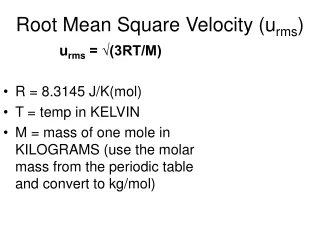
Root Mean Square Velocity (urms) urms = √(3RT/M) R = 8.3145 J/K(mol) T = temp in KELVIN M = mass of one mole in KILOGRAMS (use the molar mass from the periodic table and convert to kg/mol)
RMS Example Calculate the root mean square velocity for the atoms in a sample of oxygen gas at 0ºC. Answer: 461 m/s At 300ºC Answer: 668 m/s
Diffusion: Movement of particles from areas of higher concentration to lower concentration Effusion: The process where molecules of a gas in a container randomly pass through a hole in the container. Graham’s Law of Effusion
Graham’s Law of Effusion Rate of Effusion for gas 1 = √M2 Rate of Effusion for gas 2 √ M1 M = molar masses of the gases Example 1: Compare the rate of effusion of carbon dioxide with that of hydrogen chloride at the same temperature and pressure. Answer: CO2 effuses 0.9X as fast as HCl.
Example #2 If a molecule of neon gas travels at an average of 400m/s at a given temp., estimate the average speed of a molecule of butane gas, C4H10, at the same temp. Answer: 235m/s
Summary… Larger GFM = slower rate of effusion.
Real Gases No gas actually follows the ideal gas law Some come close at low pressures and/or high temperatures Under certain conditions (see above), gases behave more like ideal gases
Van der Waals Equation Corrects the ideal gas equation to take nonideal conditions into account (P + n2a)(V-nb) = nRT V2 P= pressure of gas (atm) V = volume of gas (L) n = moles of gas T = temperature (K) R = 0.08206 L(atm)/mol(K)
Defining Variables…MORE. a = a constant, different for each gas, that takes into account the attractive forces between molecules (table 5.3 pg. 216) b = a constant, different for each gas, that takes into account the volume of each molecule (table 5.3 pg. 216)
Example Calculate the pressure exerted by 0.3000 mol of He in a 0.2000 L container at -25.0ºC Using the ideal gas law Answer: 30.53 atm Using van der Waal’s equation Where a = 0.0341 and b = 0.0237 Answer: 31.60 atm You can calculate percent error: 3% |experimental – accepted|/accepted = ___ x 100 =
Pollution and Atmospheric Gases Your book discusses these - you can read about them at the end of chapter 5, but we will not be going over them in class…