Understanding Electrical Circuits: Series and Parallel Configurations Explained
This guide covers the fundamentals of electrical circuits, detailing the components and types of circuits: series and parallel. A circuit consists of a power supply, wires, and elements allowing current flow. Key components include batteries, switches, resistors, voltmeters, and ammeters. Series circuits allow current to flow in one path, while parallel circuits provide multiple paths. Learn how to properly connect ammeters and voltmeters for measuring current and voltage, using the PARV method: Power, Ammeter, Resistor, Voltmeter. **Relevant

Understanding Electrical Circuits: Series and Parallel Configurations Explained
E N D
Presentation Transcript
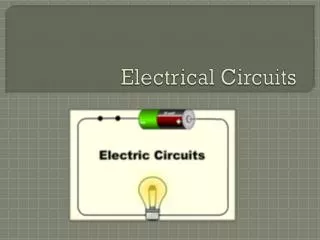
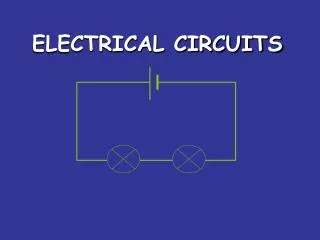
Circuits: • A circuit is made up of a power supply, connecting wires & various elements that allow current to leave a power source, travel through the elements & return back to the power source.
Common Electric Parts • Battery/Power Source • Bulb
V A Common symbols (cont’d) • Switch • Push-button Switch • Resistor • Voltmeter • Ammeter
Circuits Power Supply - + A v Ammeter Resistor Voltmeter
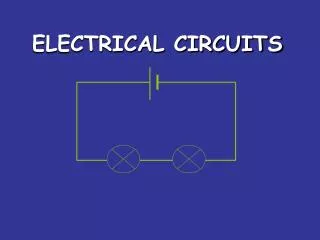
Types of Circuits: Trick to help identify type of circuit: Series: Current has only one option to flow Parallel: Current has more than one option to flow through • There are 2 types of circuits: • 1. Series Circuit • 2. Parallel Circuit SERIES PARALLEL
Series Circuits • Components are connected end to end • Current only follows one path • If one part of the circuit is broken, the entire circuit will stop functioning • Eg: Christmas tree lights
Parallel Circuits • Circuit that contains at least one branch • Current can follow at least 2 different paths • If part of the circuit is defective another part may still be able to operate. • Eg: headlights on a car
A A Example Series or Parallel? 2. 1. PARALLEL SERIES 3. 4. SERIES PARALLEL
Adding an Ammeter into a Circuit • In order to measure the current traveling through a circuit, an ammeter must be inserted into the circuit. • An ammeter is always connected inside the circuit in series. A
Connecting An Ammeter In each diagram, is the ammeter hooked up correctly to these circuits? A) B) C) A A NO A YES YES F) E) D) NO A YES NO A A
Adding a Voltmeter to a Circuit • In order to measure the voltage traveling through a circuit, a voltmeter must be inserted into the circuit. • A voltmeter is always connected outsidethe circuit in parallel. V
Connecting A Voltmeter In each diagram, is the voltmeter hooked up correctly to these circuits? V A) B) C) V V NO YES YES F) E) D) V YES V YES NO V
KEY POINTS • Voltmeter – always placed outside of circuit attached in parallel • Ammeter – is always placed inside circuit attached in series
Setting up a Circuit • PARV acronym • P-ower • A-mmeter • R-esistor • V-olt Meter