

SlideServe
Menu
Préférences
© SlideServe · v2026

Discrete Math

reneea avatar
8 diapositives · 135 Views · Dec 19, 2019

Explore weighted voting systems, quotas, dictators, Banzhaf Power Index, Shapley-Shubik Power Index, and more in discrete math Chapter Two. Learn about players, coalitions, and critical players in formal voting arrangements.
Discrete Math - slide 1
01 / 8Discrete Math
1 / 17

Télécharger la présentation

Discrete Math
Une image / un lien ci-dessous est fourni (tel quel) pour télécharger la présentation

Politique de téléchargement : le contenu du site vous est fourni TEL QUEL pour votre information et votre usage personnel ; il ne peut être vendu, concédé sous licence ni partagé sur d’autres sites sans l’accord de son auteur.Le contenu vous est fourni TEL QUEL, pour votre information et votre usage personnel uniquement. Téléchargez la présentation en cliquant sur ce lien. Lors du téléchargement, si vous ne parvenez pas à télécharger une présentation, l’éditeur a peut-être supprimé le fichier de son serveur.Pendant le téléchargement, si vous ne parvenez pas à obtenir une présentation, le fichier a peut-être été supprimé par l’éditeur.

F I N

Plus de contenu associé

Transcription de la présentation
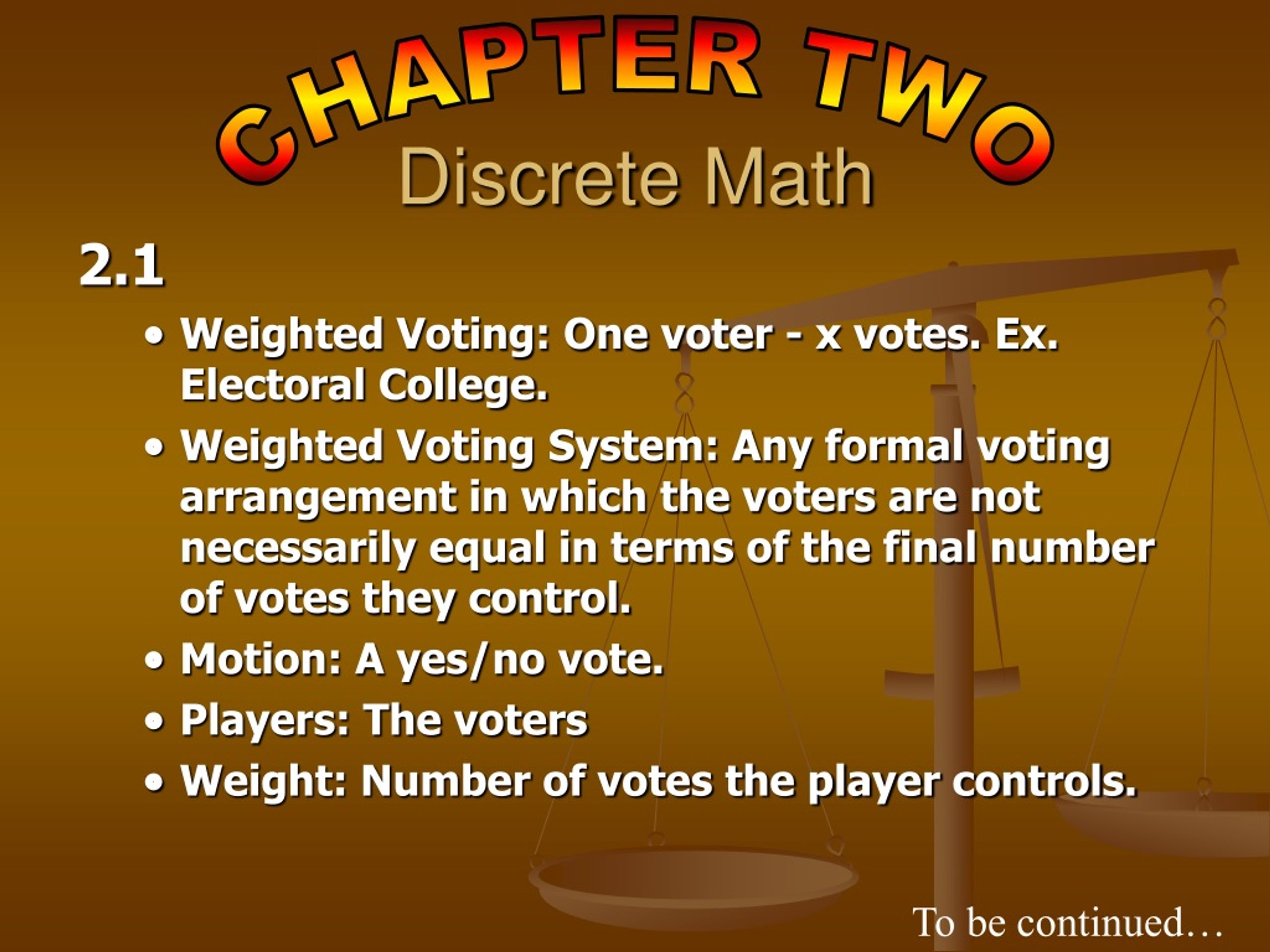
  1. Discrete Math CHAPTER TWO 2.1 • Weighted Voting: One voter - x votes. Ex. Electoral College. • Weighted Voting System: Any formal voting arrangement in which the voters are not necessarily equal in terms of the final number of votes they control. • Motion: A yes/no vote. • Players: The voters • Weight: Number of votes the player controls. To be continued…

  2. Discrete Math CHAPTER TWO 2.1 (Continued...) • Quota: The minimum number of votes needed to pass a motion. • May be something other than the majority. • Notation: [Q :w1, w2, w3, ...] • Dictator: A player that has a weight equal to or larger than the quota. • Dummy: A player with no power. • Veto Power: A player that is not a dictator, but can single-handedly prevent the rest of the players from passing a motion.

  3. Discrete Math CHAPTER TWO 2.2 • Banzhaf Power Index: Method of calculation Power. • Coalition: Any set of players that might join forces to vote together. • Winning Coalition: Has enough votes to win. • Losing Coalition: Does not have enough votes to win. • Critical Player: Players whose desertion turns a winning coalition into a losing coalition. To be continued…

  4. Discrete Math CHAPTER TWO 2.2 (Continued...) • Steps: • One: Make a list of all possible coalitions. • Two: Determine which of the above are winning coalitions. • Three: Determine the critical players in each winning coalition. • Four: Count the number of times each player is critical (B). • Five: Count the total of times all players are critical() and create the power for each player as B/T… may write as percentage. To be continued…

  5. Discrete Math CHAPTER TWO 2.2 (Continued...) • Number of possible coalitions: 2n-1 • Sometimes we can save ourselves a lot of work by figuring out directly which are the winning coalitions instead of listing all of them. Range of Quota: Sum of weights / 2 < Q <= Sum of weights

  6. Discrete Math CHAPTER TWO 2.3 • Shapley-Shubik Power Index: • Sequential Coalition: Difference in Shapley-Shubik and Banzhaf, coalitions are assumed to be formed sequentially. • The Number of Sequential Coalitions: N! • Pivotal Player: The player joins the coalition and causes the coalition to change from losing to winning. To be continued…

  7. Discrete Math CHAPTER TWO 2.3 (Continued...) • Steps: • One: Make a list of all sequential coalitions. • Two: In each coalition determine the pivotal player. • Three: Count the total number of times P is pivotal and call this number S. The Shapley-Shubik power index of each player will be calculated as S/N!. (Fraction or Percentage)

  8. 2 End of Chapter Discrete Math CHAPTER TWO