Download
1 / 5
50 likes | 175 Vues
This guide outlines essential factors for implementing student peer review in online courses at OSU. It explores whether students should select their own partners or be assigned specific ones, as well as the importance of providing rubrics for clarity and consistency. The document emphasizes the need for clear task specifications to enhance student engagement and understanding. Additionally, it highlights strategies to help students make effective comments, encouraging specificity in feedback and providing incentives for participation. Useful resources, such as RubiStar for rubric creation, are also mentioned.

E N D
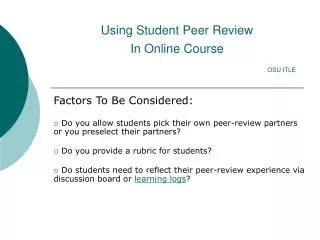
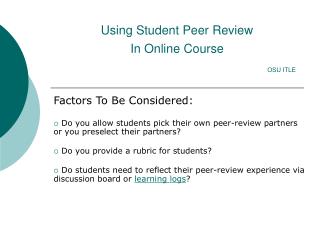
Using Student Peer ReviewIn Online CourseOSU ITLE Factors To Be Considered: Do you allow students pick their own peer-review partners or you preselect their partners? Do you provide a rubric for students? Do students need to reflect their peer-review experience via discussion board or learning logs?
Specification of Tasks • Tasks should be clear and precise; students often prefer a worksheet that notes specific tasks. • If students are given multiple peer-review opportunities, they often feel comfortable moving through a sequence from simply identifying a feature to evaluating it to suggesting revisions. • Students need extra time for longer the paper or if the assessment criteria is complex. Source: Merseth, K. (1991). The early history of case-based instruction: Insights for teacher education today. Journal of Teacher Education, 42 (4), 243-249.
Helping Students Make Effective Comments • encourage students to be as specific as possible, both about strengths and weaknesses. • give students incentives to peer review, such as including effective peer review as part of the overall grade for the paper. • use a rubric so that students won’t fee overwhelmed and can stay focused. Click RubiStar to see how it can help faculty who don’t have time to create rubrics from scratch.