Understanding Physics: The Exploration of Natural Phenomena
Humans have always been curious about the natural world, from the captivating night sky to the cycles of day and night and the mysteries of eclipses and tides. Physics seeks to systematically understand these phenomena through scientific methods, including observations, experiments, and mathematical modeling. Key milestones in physics, such as Rutherford's nuclear model of the atom and Dirac's introduction of the antiparticle concept, demonstrate the evolving nature of this field. This exploration not only satisfies curiosity but also aids in predicting and controlling natural events.

Understanding Physics: The Exploration of Natural Phenomena
E N D
Presentation Transcript
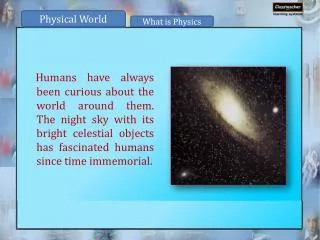
Physical World What is Physics Humans have always been curious about the world around them. The night sky with its bright celestial objects has fascinated humans since time immemorial.
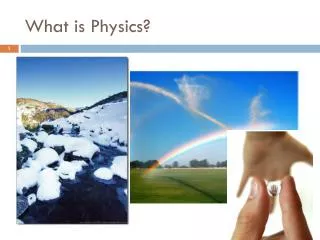
Physical World What is Physics The regular repetitions of the day and night, the annual cycle of seasons, the eclipses, the tides, the volcanoes, the rainbow have always been a source of wonder.
Physical World What is Physics Science is a systematic attempt to understand natural phenomena in as much detail and depth as possible, and use the knowledge so gained to predict, modify and control phenomena. Science is exploring, experimenting and predicting from what we see around us. The scientific method involves several interconnected steps : • Systematic observations, • controlled experiments, • qualitative and quantitative reasoning, • mathematical modelling, • prediction and verification
Physical World What is Physics The result of experiment , in 1911 by Ernest Rutherford established the nuclear model of the atom, which then became the basis of the quantum theory of hydrogen atom given in 1913 by Niels Bohr . On the other hand, the concept of antiparticle was first introduced theoretically by Paul Dirac in 1930 and confirmed two years later by the experimental discovery of positron (antielectron) by Carl Anderson.