SlideServe
Menu
Préférences
© SlideServe · v2026

Water is the solvent of life.

reya avatar
7 diapositives · 544 Views · Jul 28, 2014

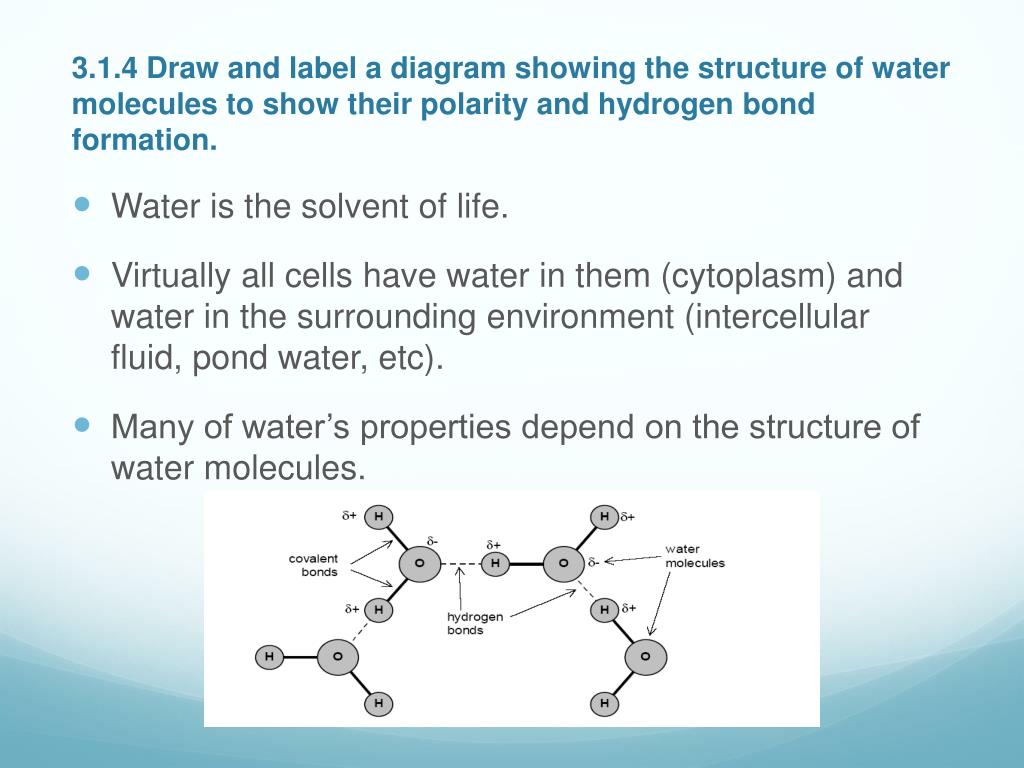
3.1.4 Draw and label a diagram showing the structure of water molecules to show their polarity and hydrogen bond formation. Water is the solvent of life. Virtually all cells have water in them (cytoplasm) and water in the surrounding environment (intercellular fluid, pond water, etc).
Water is the solvent of life. - slide 1
01 / 7Water is the solvent of life.
1 / 17

Télécharger la présentation

Water is the solvent of life.
Une image / un lien ci-dessous est fourni (tel quel) pour télécharger la présentation

Politique de téléchargement : le contenu du site vous est fourni TEL QUEL pour votre information et votre usage personnel ; il ne peut être vendu, concédé sous licence ni partagé sur d’autres sites sans l’accord de son auteur.Le contenu vous est fourni TEL QUEL, pour votre information et votre usage personnel uniquement. Téléchargez la présentation en cliquant sur ce lien. Lors du téléchargement, si vous ne parvenez pas à télécharger une présentation, l’éditeur a peut-être supprimé le fichier de son serveur.Pendant le téléchargement, si vous ne parvenez pas à obtenir une présentation, le fichier a peut-être été supprimé par l’éditeur.

F I N

Plus de contenu associé

Transcription de la présentation
  1. 3.1.4 Draw and label a diagram showing the structure of water molecules to show their polarity and hydrogen bond formation. • Water is the solvent of life. • Virtually all cells have water in them (cytoplasm) and water in the surrounding environment (intercellular fluid, pond water, etc). • Many of water’s properties depend on the structure of water molecules.

  2. Water molecules are charged, with the oxygen atom being slightly negative (δ-) and the hydrogen atoms being slightly positive (δ+). These opposite charges attract each other, forming hydrogen bonds. These are weak, long distance bonds that are very common and very important in biology.

  3. Water • Hydrogen and oxygen atoms in a single water molecule are held together by a polar covalent bond. • This type of bond results from an unequal sharing of electrons. • The single oxygen atom is bonded to two different hydrogen atoms. • Each oxygen-hydrogen bond is a polar covalent bond and results in a slight negative charge at the oxygen end of the molecule and a slight positive charge at the end with two hydrogens. • Because the two end of each water molecule have opposite charges, water molecules interact with other in very interesting ways.

  4. 3.1.5 Outline the thermal, cohesive and solvent properties of water. • Water has a number of important properties essential for life. Many of the properties below are due to the hydrogen bonds in water. • Thermal properties • Specific heat capacity • Latent heat of vaporization • Latent heat of fusion • Cohesive properties • Solvent properties Make notes on what these terms mean.

  5. Thermal properties Specific heat capacity • Water has a specific heat capacity of 4.2 J g-1 °C-1, which means that it takes 4.2 joules of energy to heat 1 g of water by 1°C. This is unusually high and it means that water does not change temperature very easily. This minimises fluctuations in temperature inside cells, and it also means that sea temperature is remarkably constant.  Latent heat of vaporization • Water requires a lot of energy to change state from a liquid into a gas, and this is made use of as a cooling mechanism in animals (sweating and panting) and plants (transpiration). As water evaporates it extracts heat from around it, cooling the organism.  Latent heat of fusion • Water also requires a lot of heat to change state from a solid to a liquid, and must loose a lot of heat to change state from a liquid to a solid. This means it is difficult to freeze water, so ice crystals are less likely to form inside cells.

  6. Cohesion Water molecules "stick together" due to their hydrogen bonds, so water has high cohesion. This explains why long columns of water can be sucked up tall trees by transpiration without breaking. It also explains surface tension, which allows small animals to walk on water.

  7. Solvent Because it is charged, water is a very good solvent. Charged or polar molecules such as salts, sugars, amino acids dissolve readily in water and so are called hydrophilic ("water loving"). Uncharged or non- polar molecules such as lipids do not dissolve so well in water and are called hydrophobic ("water hating").