Revolutionizing Material Development Through Advanced Microstructure Modeling Techniques
The performance of materials is intricately linked to their microstructure, and advancing this understanding can drastically reduce the time and cost associated with material development. At the University of Illinois, through the Center for Process Simulation and Design, we use state-of-the-art computational methods to model microstructure formation, integrating length scales from atomic to macroscopic. Our innovative techniques, including adaptive grids and renormalization group theory, are leading the way in materials processing simulations, enhancing our capacity to predict and manipulate material behavior.

Revolutionizing Material Development Through Advanced Microstructure Modeling Techniques
E N D
Presentation Transcript
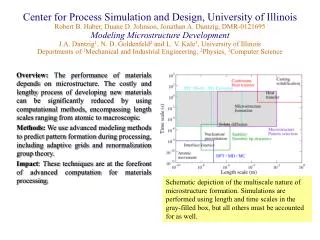
Center for Process Simulation and Design, University of IllinoisRobert B. Haber, Duane D. Johnson, Jonathan A. Dantzig, DMR-0121695Modeling Microstructure DevelopmentJ.A. Dantzig1, N. D. Goldenfeld2 and L. V. Kale3, University of IllinoisDepartments of 1Mechanical and Industrial Engineering, 2Physics, 3Computer Science Overview: The performance of materials depends on microstructure. The costly and lengthy process of developing new materials can be significantly reduced by using computational methods, encompassing length scales ranging from atomic to macroscopic. Methods: We use advanced modeling methods to predict pattern formation during processing, including adaptive grids and renormalization group theory. Impact: These techniques are at the forefront of advanced computation for materials processing. Schematic depiction of the multiscale nature of microstructure formation. Simulations are performed using length and time scales in the gray-filled box, but all others must be accounted for as well.