UNIT 10. CLIL LESSON PLANNING
UNIT 10. CLIL LESSON PLANNING. Aims of the unit. Describe instructional indicators and strategies for classroom organization and elivery on instruction. INTRODUCTION TO CLIL LESSON PLANNING. Specific needs : First language Educational background Literacy levels Living situation

UNIT 10. CLIL LESSON PLANNING
E N D
Presentation Transcript
UNIT 10. CLIL LESSON PLANNING JSP 2010-2011
Aims of theunit • Describe instructionalindicators and strategiesforclassroomorganization and eliveryoninstruction. JSP 2010-2011
INTRODUCTION TO CLIL LESSON PLANNING • Specificneeds: • Firstlanguage • Educationalbackground • Literacylevels • Living situation • Culture • Socioeconomic status • Expectations • Lifeexperiences JSP 2010-2011
SHELTERED INSTRUCTION • http://mediateca.educa.madrid.org/reproducir.php?id_video=vkxzo27wv5dea9ev • Listen and take notes (15 min.) JSP 2010-2011
SHELTERED INSTRUCTION • Providingmeaningfulinstruction in contentareasfortransitioningLimitedEnglishProficientstudents (LEP) tohigheracademicachievementwhilereachingEnglishfluency. • Thecontentisequaltothat of nativeEnglishspeakers • Variedmethods of instruction • Doesnotfocusentirelyonlanguagedevelopment, butonmethodsthroughwhichEnglishisachieved. JSP 2010-2011
STRATEGIES • Set format of instruction • Define clearlylanguage and content • Maketheactivitymeaningful • Classroomconcepts: • Hands-on • Controlledvocabulary • Scaffolding • Authenticassessment • Heterogeneousgrouping JSP 2010-2011
SHELTERED INSTRUCTION PROTOCOL • www.siopinstitute.net • Modelforlessonplanning • Meansfor • makingcontent more accessible • PromotingEnglishlanguagedevelopment • Practice of highlightingkeylanguagefeatures and incorporatingstrategies • Developedbythe Centre forResearchonEducation, Diversity and Excellence (CREDE) JSP 2010-2011
CREDE’S PHILOSOPHY • Allchildren can learn • Childrenlearnbestwhenchallengedbyhighstandards • Englishproficiencyisattainablebyeverybody • Bilingualproficiencyisdesirable • Language and cultural diversity • Teaching and learningmustaccomodateindividuals • Schools can mitigateriskfactorsbyteaching social and learningskills • Solutionstoriskfactorsmustbegrounded in a valid general theory of development, teaching and schoolingprocesses. JSP 2010-2011
TYPES OF SHELTERED PROGRAMMEES • Content-based ESL: focusonlanguagedevelopment. • Shelteredinstruction: focusoncontentcurricula. JSP 2010-2011
THE EIGHT STEPS • Lessonpreparation • Clearly define contentobjectives • Clearly define languageobjectives • Buildingbackground • Student’sexperience • Old and new • Key vocabulary • Comprehensible input • Speaking • Stepbystep • Variety of techniques • Strategylearning • Strategies • Explicitinstruction • Use • Scaffoldingtechniques • Social-affectivestrategies • Cooperativelearning: think – pair – share • Affectivefilter (Krashen) JSP 2010-2011
THE EIGHT STEPS • Interaction • Frequent • Grouping • Time • Clarification • Practice / Application • Hands-onmaterials • Activitiesforapplyingknowledge • Languageskillsintegrated • Lessondelivery • Supportcontentobjectives • Supportlanguageobjectives • Engagestudents • Appropriatetiming • Review/ Assessment • Vocabulary: mnemonics • Content wordwall • Content concepts • Feedback • Studentcomprehension and learning JSP 2010-2011
TEACHING READING PROCESS • Survey • Question • Predict • Read • Respond • Summarize JSP 2010-2011
EXAMPLES JSP 2010-2011
examples • www.isabelperez.com/clil.htm • www.clilcompendium.com • www.clil-axis.net • www.cilt.org.uk/faqs/clil.htm • www.xtec.cat/crle/05/aicle.htm • www.factworld.info • www.diposit.ub.edu./dspace/handle/2445/1641 • www.scribd.com/doc/3273805/Published-Material-for-CLIL-Classes-Spain JSP 2010-2011
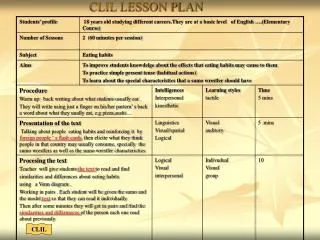
Task: Design a lessonplanningaccordingtothetechniquespresentedduringthelesson. Use thewebsitesforhelp. • http://cefire.edu.gva.es/sfp/index.php?seccion=convocatoria&id=27&edicion=2CAS01-ANGLB&clave=1b73a2394c1d12d0c49de03453213e23 JSP 2010-2011
SEE YOU ON MAY, 3rd JSP 2010-2011 THANK YOU