
Positive Role Modeling for Youth Development & Excellence in Agriculture
E N D
Presentation Transcript
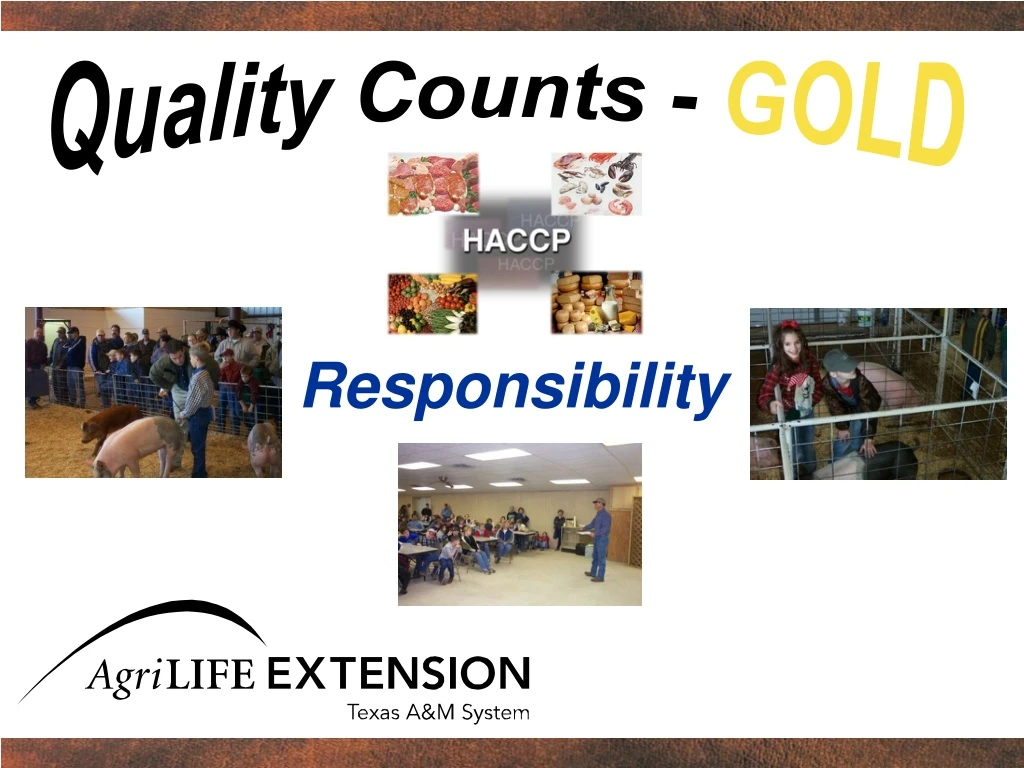
Quality Counts -GOLD Responsibility
Overview • Importance of positive role modeling • Doing your best and striving for excellence • Providing educational resources to young people • Emphasizing the importance of animal welfare • Teaching the importance of food safety when raising livestock
Positive Role Modeling • Adults have the responsibility to be positive role models and set good examples. • This includes: • Engaging in ethical practices • Demonstrating good sportsmanship • Providing resources young people need • Producing safe food products
Role Modeling • As young people develop, they seek role models. • Role model – a person who serves as a model in a particular behavioral or social role for another person to emulate • Positive role models are essentialfor youth development.
Role Modeling in Society • Young people find both positive and negative role models in today’s society. • Young people often idealize sports figures, yet many athletes have been accused of using performance-enhancing drugs. • These negative role models may make it seem acceptable to use performance-enhancing drugs in livestock.
Positive Role Models in Society • As society becomes more complex, positive role models are harder to find. • Societal influences that affect the unity of young people and adults: • Increased mobility • Distancing from relatives • Sports icons • Generational differences • Every young person needs a positive relationship with at least one adult. • Ideally, young people will have positive relationships with: • Church leaders • School leaders • Business leaders • Other “positive” leaders
What is a positive role model? • A positive role model demonstrates character traits such as: • Groups that serve as role models include: • Trustworthiness – Fairness • Respect – Caring • Responsibility – Citizenship • County Extension agents – Master volunteers • Agricultural science teachers – Family members • Project committee members – Other adult volunteers
Sportsmanship vs. Gamesmanship • It is the responsibility of adults to teach young people about showmanship both inside and outside the ring. • Young people must understand the difference between sportsmanship and gamesmanship. Sportsmanship – exhibiting livestock with honor Gamesmanship– striving to win for gain and glory
Sportsmanship • Examples of good showmanship • Picking up a show stick someone drops in the ring • Teaching a younger exhibitor how to clip and fit a steer • Opening a gate for someone who has a pig penned • Letting another exhibitor borrow a brush • Taking leadership of the county/chapter showmanship training to help others • Sharing your knowledge about selecting projects with others • Helping a younger exhibitor carry a bucket of water
Gamesmanship • Examples of gamesmanship • Jabbing someone else’s animal in the show ring • Being dishonest about an animal’s age when registering • Showing an animal in the wrong breed or division • Telling the judge that your animal weighs a different amount than the card says • Blocking the judge’s view of another animal in the class • Depriving your animal of the appropriate amount of feed and water to get its weight down • Providing compensation to the judge to influence his or her decision
Doing Your Bestand Striving for Excellence • Making ethical choices involves choosing to do your best, strive for excellence, pursue victory, and display accomplishments with honor. • It does not involve giving in to unethical practices in order to win. • Competitors expect to compete, not to forfeit to their opponents. • When times get tough, parents and adult leaders should demonstrate the following practices: • Perseverance • Diligence • Hard work • Accountability • Self restraint • Search for improvement
Striving for Excellence • The ancient Greek definition of happiness was the full use of your powers along lines of excellence. John F. Kennedy • Be a yardstick of quality. Some people aren't used to an environment where excellence is expected. Steve Jobs • The quality of a person’s life is in direct proportion to their commitment to excellence, regardless of their chosen field of endeavor. Vincent T. Lombardi
Providing Educational Resources for Young People • The educational resources adults provide can help young people better appreciate and understand agriculture. • Resources may include: • Extension publications • Extension specialists and agents • Feedback from project experts • Master volunteers • 4-H and FFA curricula • Extension trainings • 4-H and FFA camps
Animal Welfare • Young people must learn personal accountability when raising livestock. • They are accountable for the methods they use. • Raising livestock requires commitment. • Feeding and watering daily • Safe handling of livestock • Giving only prescribedmedications and feeds • Providing a safe environmentfor animals • Treating livestock that are sick
Food Safety • Market livestock projects account for nearly7 million pounds of meat each year. • Adult leaders must emphasize the importance of producing safe, high-quality meat. • Adults should help young people understand Food Quality Assurance and learnto use Hazard AnalysisCritical Control Plans (HACCP).
Food Quality Assurance • Established in 1979 by federal government • Monitors the production, processing and distribution of all food products • Eliminated overlapping, inconsistent, complex specifications for various food products • Goal – help consumers buy foodas efficiently and economically aspossible while taking advantageof the innovations and efficienciesof the commercial marketplace
Food Quality Assurance • Responsibilities of Food Quality Assurance Program: • Assure food quality and manage Commercial Item Descriptions (CID) • Coordinate CIDs with users, regulatory agencies, inspection and testing agencies, and the food industry • Review CIDs to ensure document requirements conform to applicable laws, regulations and policies • Approve CIDs, as appropriate, and arrange for their printing, indexing and distribution • Maintain a complete and current inventory of CIDs
Hazard Analysis Critical Control Points (HACCP) • Plans that identify where and how food safety problems occur and how they can be prevented • HACCP plans should be used with 4-H/FFA livestock projects. They ensure that meat will be safe and wholesome for the consumer.
Hazard Analysis Critical Control Points (HACCP) • When implementing HACCP plans: • Identify hazards • Find critical control pointsfor each hazard • Establish critical limits foreach control point • Monitor • Take corrective action if thereis a problem • Keep records on each critical control point • Verify that the HACCP plan is working correctly
Conclusion • Importance of • Positive role modeling (sportsmanship vs. gamesmanship) • Doing your best and striving for excellence • Providing young people with educational resources • Animal welfare • Food safety (Food Quality Assurance, HACCP)