Download
1 / 43
430 likes | 555 Vues
This session, led by Patricia Coward, Principal Adviser at the Occupational Health Unit, clarifies the differences between seasonal, pandemic, and avian influenza. It highlights seasonal influenza's predictable patterns and at-risk groups, while emphasizing the severe nature and unpredictability of pandemic influenza. Additionally, the overview addresses avian influenza's potential risks to humans, especially from the H5N1 strain. Attendees will learn effective infection control practices essential for safeguarding students and staff during a pandemic, including vaccination, hand hygiene, and social distancing measures.

E N D
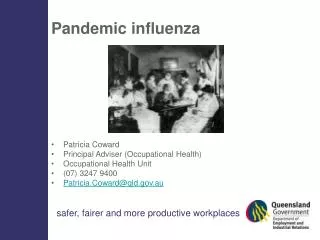
Pandemic influenza • Patricia Coward • Principal Adviser (Occupational Health) • Occupational Health Unit • (07) 3247 9400 • Patricia.Coward@qld.gov.au
Session overview • What is the difference between seasonal influenza, pandemic influenza and avian influenza (bird flu)? • Infection control practices to protect staff and students in the event of pandemic influenza
Seasonal influenza • Occurs each winter in Australia • New strain each winter • It is reasonably predictable because it is similar to previous influenza strains
Seasonal influenza • Some groups are at greater risk from seasonal influenza • Persons 65 years of age and over • Aboriginal and Torres Strait Islander persons aged 50 years and over • Chronic disease • Immunosuppression • Residents of long-term care establishments • Pregnant women
Pandemic influenza • Pandemic influenza is a severe form of influenza that infects many people around the world at the same time • Occurs when a new strain of influenza virus emerges to which no-one has immunity • Can occur at any time of the year and lasts longer than seasonal influenza
Pandemic influenza • Causes more severe illness and death • All people may be at risk, not just the usual ‘at-risk’ groups • The only predictable thing about pandemic influenza is its unpredictability
Avian influenza • Disease of birds caused by an avian (bird) influenza virus • Usually infects aquatic birds • Can also infect domestic birds and some animals
Avian influenza • Historically, human infection with avian influenza viruses has been rare and mild • Human infection with the H5N1 strain of avian influenza is rare but it can cause serious human infection with a high death rate • > 60% • WHO 19th June 2008 • 385 confirmed cases • 243 confirmed deaths
Avian influenza • Children and young adults are most at risk from H5N1 • 90% of cases are < 40 years of age • 52% of cases are < 20 years of age
Avian influenza • H5N1 is circulating in wild and domestic bird flocks in many parts of Asia, Africa and Europe • H5N1 has pandemic potential • There is concern that H5N1 could mutate to cause the next human influenza pandemic
Pandemic alert level • The world is on pandemic alert level 3
Pandemic planning • Tertiary education facilities are at significant risk for pandemic influenza • Colleges and universities pandemic influenza checklist • http://www.pandemicflu.gov/plan/school/collegeschecklist.html
Assumptions • A pandemic is likely to be widespread throughout Queensland • May last up to 12 months • May be 2 or more pandemic waves each lasting about 8 weeks • Healthcare system will be overloaded
Pandemic planning • Social distancing within the community • Inadequate supplies • Significant absenteeism for a prolonged period
Protecting staff and students • Vaccination • May not be available at the start of a pandemic • Antiviral medications • Availability will be restricted • Infection control • Criticalcontrol for protecting staff and students • Based on influenza’s modes of transmission
How is influenza spread? • Contact transmission • Occurs when you have contact with an infected person or a contaminated surface • Transfer influenza virus to your eyes, nose and mouth via your hands
How is influenza spread? • Droplet transmission • Occurs when an infected person releases droplets containing influenza virus when they cough, sneeze or talk • The droplets land on your eyes, mouth and nose if you are within about 1 metre distance of the person
How is influenza spread? • Airborne transmission • Occurs when you inhale aerosols of influenza virus • Risk for healthcare workers who perform aerosol generating procedures • No evidence that influenza is spread through air-conditioning systems
Infection control for pandemic influenza http://www.health.sa.gov.au/infectioncontrol/
Hand hygiene • Regularly wash hands with soap and water or apply alcohol-based hand rub
Respiratory hygiene and cough etiquette • Cough or sneeze into a disposable tissue • If no tissue available, cough or sneeze into sleeve • Perform hand hygiene after coughing and sneezing X
Cleaning programs • Regular cleaning of • Shared surfaces • Surfaces that are frequently touched • Cleaning agents • Water and detergent • Alcohol-based disinfectant
Social distancing • Restrict non-essential face-to-face contact • Conduct business by alternative ways that minimise face-to-face contact • Ensure supporting communications systems • Staff and students able to work from home
Social distancing • Where essential face-to-face contact is required • Sit > 1 metre apart • Hold the meeting outdoors if practicable • Stagger start, finish and break times so that fewer people are using workplace facilities and public transport at the same time • Postpone work recreational activities
Social distancing • Promote spatial separation at the office • Arrange work stations >1 metre apart • Transparent screens at face-to-face customer service areas
Personal protective equipment • Disposable gloves for tasks that involve contact with potentially contaminated surfaces • Vinyl, nitrile or powder-free latex gloves • Perform hand hygiene after glove removal
PPE • Surgical masks for • Staff who develop influenza illness at work • Contain their coughs and sneezes • Staff who have face-to-face contact with others
Work restrictions • Restrict workplace entry • Display notices at workplace entry points advising people not to enter if they have influenza symptoms
Work restrictions • Exclude sick family members from the workplace • Exclude infected children from family rooms • Exclude staff who are contacts of infected people • Should be in quarantine for 7 days from the time that their contact became ill
Managing sickness at work • If a person develops pandemic influenza symptoms at work • Separate the person from other workers • First aid or family room
Managing sickness at work • Provide the person with • Surgical mask and tissues • Alcohol-based hand gel to sanitise their hands and prevent contamination of their work surfaces • Influenza kit for managing sick workers • Surgical masks, alcohol-based hand gel, tissues, disinfectant, disposable gloves, garbage bags
Managing sickness at work • Send the person home promptly • Most contagious at the onset of symptoms • Clean and disinfect the sick person’s workstation once they have left • Identify recent close work contacts and advise them of the situation • May require isolation • Train first aid personnel
Vaccination • Maintain annual seasonal influenza vaccination • Seasonal influenza strains may continue to circulate during a pandemic • Encourage vaccination once a pandemic influenza vaccine becomes available
Stockpiling • “The decision made now not to stockpile means that you have made the decision not to protect your workers during a pandemic”
Campus health services • May be the first to see cases of suspected pandemic influenza • May have to provide care to sick students and staff if hospitals, GPs and community influenza clinics are overwhelmed • International students • Students residing in student housing
Campus health services • Medical offices and clinics pandemic influenza planning checklist http://www.pandemicflu.gov/plan/healthcare/medical.html • Stockpile medical consumables, including hand hygiene products, PPE and antivirals
Campus health services • Triage system to identify and separate persons presenting with influenza symptoms from others • Single room with ventilation that is not recirculated to other rooms within the facility • Shaded outdoor area • Provide infected persons with a surgical mask to contain coughs and sneezes
Campus health services • P2 respirators for healthcare workers, clinic administrative staff and others • Respirator fit test • AS 1715:1994 Selection, use and maintenance of respiratory protective devices • “In order for the designed performance to be achieved by a respirator, it is essential the respirator be properly fitted to the individual to whom it is assigned”
Campus health services • Fit check • User seal check performed each time the respirator is donned • Respirator ready • Clean shaven
Campus health services • Clinic security • Infection control training • Staff fatigue and work overload • Clinic staff who may be at high risk from acquiring pandemic influenza • Pregnant staff • Monitor clinic staff for influenza illness
Campus health services • Commonwealth Department of Health & Ageingwww.health.gov.au • Interim Infection Control Guidelines for Pandemic Influenza in Healthcare and Community Settings • Prepared and protected DVD • Queensland Healthwww.health.qld.gov.au • Pandemic Influenza – Infection Control for Healthcare Workers DVD • Available from the Communicable Diseases branch of Queensland Health (07) 3234 1155 • Royal Australian College of General Practitioners