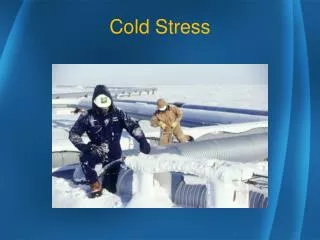
Cold Stress
Cold Stress. Training Objectives. By the end of the session you will: Know what cold stress is Understand the WorkSafeBC Regulations Understand the risks Know how to control the risk Be able to identify symptoms Know first aid response. Agenda. Definitions Regulations

Cold Stress
E N D
Presentation Transcript
Training Objectives • By the end of the session you will: • Know what cold stress is • Understand the WorkSafeBC Regulations • Understand the risks • Know how to control the risk • Be able to identify symptoms • Know first aid response
Agenda • Definitions • Regulations • Responsibilities • Hazard Identification
Agenda • Risk Assessment • Risk Controls • Recognizing Symptoms • First Aid Procedures
Definitions • Accidental Exposure • Artificially Cold Workplace • Cold-Related Injuries • Cold Stress • Equivalent Temperature • Hypothermia
Regulation • The Regulation applies if workers may be exposed to thermal conditions that: • May cause cold stress injury • Could cause core body temp to fall • Are below ACGIH acceptable levels
Regulation • Assessment and exposure control • Cold stress controls • Heated shelters • Clothing and PPE
Responsibilities • Employer • Conduct risk assessments • Develop and implement exposure control plan • Provide training • Provide heated shelter or vehicle
Responsibilities • Employer – continued • Maintain records • Ensure adequate first aid coverage
Responsibilities • Managers • Ensure that a cold stress assessment is performed • Provide administrative controls • Ensure protective clothing is available • Ensure workers receive training
Responsibilities • Supervisors • Known or reasonably foreseeable cold hazards • Health and safety of all workers • Safe work practices
Responsibilities • Workers • Follow safe work procedures • Seek shelter if displaying symptoms of hypothermia • Wear adequate clothing • Avoid getting wet
Responsibilities • Workers – continued • Wear eye protection when warranted • Wear PPE
Responsibilities • Joint OHS Committee • Advise the Employer onprocedures and systems • Help evaluate workplace conditions • Deal with worker complaints • Help with incident investigations and worksite inspections
Risk Identification • Environmental Hazards • Job or Task-Related Hazards • Personal Risk Hazards
Risk Identification • Environmental Risks • Observe conditions and note hazards • Determine risks of accidental exposure • Look at previous history of exposure to cold • Conduct risk assessment if hazard(s) is present
Risk Identification • Job / Task Related Risks • Observe the tasks • Determine hazards that may expose workers to risk • If task-related hazard is present implement controls
Risk Identification • Personal Risks • Poor physical fitness • Not used to working in the cold • Cold or other flu like symptoms • Chronic illness or circulatory problems • Using certain drugs or medication • Exhibiting symptoms of fatigue • Vibration white finger disease
Risk Assessment • Documentation • Taking measurements • Categorizing the risk • Vibration and accidental exposure • Accidental exposure • Conditions that require a mandatory assessment
Risk Assessment • Cold Stress Risk Assessment Form • Section One • Section Two • Measurements • Category and control • Hand/arm vibration • Accidental exposure
Risk Assessment • Conditions Requiring Assessment • Conditions that cold cause cold stress or injury • Conditions that could cause worker’s core body temperature to fall below 36C • Conditions below levels classed by ACGIH as “little danger”
Risk Controls • Working in hazardous wind chill conditions • Contact with cold surfaces • Bare hands in a cold environment • Administrative controls • Personal Protective Equipment & Clothing
Risk Controls • Wind Chill Conditions • Heated shelter or vehicle to be available • Worker instructions • Workers must wear adequate protective clothing
Risk Controls • Contacting Cold Surfaces • Protective clothing and equipment • Wear protective gloves, mittens and footwear • Wear insulated gloves when surfaces are colder than -7C • Avoid skin contact with cold surfaces
Risk Controls • Hand Protection • Warm air jets, radiant heaters or warm contact plates for hand warming • Controls designed for operation by gloved hands
Risk Controls • Administrative Controls • Adjustment to the cold • Reduce activities performed outdoors • Remain well hydrated • Eat properly according to the cold climate • Establish a buddy system
Risk Controls • Personal Protective Clothing and Equipment • Wear insulated outer clothing • Use protective clothing in controlled environments • Change out of wet clothing
Risk Controls • Personal Protective Clothing and Equipment – continued • Immediately change to dry clothing if immersed in water • Wear PPE if danger of frostbite
Prevention • Understanding the personal risk factors • Following safe work practices • Proper use of clothing • Using shelters • Following guidelines for eating and drinking
Prevention • Personal Risk Factors • Poor physical fitness • Not used to working in the cold • Cold or other flu like symptoms • Chronic illness or circulatory problems • Using certain drugs or medication that inhibit the body’s response to the cold or impairs judgment • Vibration white finger disease
Prevention • Safe Work Practices • Use a “buddy system” • Do a regular “self-check” for symptoms • If you discover a cold-related injury NOTE: this last point isn’t finished.
Prevention • Proper use of clothing • Under Layer • Insulating Layer • Outer Layer
Prevention • Use of Shelters • Provide shelters at -7C or below • Use shelters at regular intervals • Remove outer clothing and allow ventilation • Assess cold injury or hypothermia victims
Prevention • Eating and Drinking Guidelines • High caloric intake is recommended for cold work • Warm sweet drinks available • Drink frequently • Avoid coffee • Avoid alcohol
Recognizing Symptoms • Mild Hypothermia • Moderate Hypothermia • Severe Hypothermia • Frostnip & Frostbite
Recognizing Symptoms • Mild Hypothermia • Feel chilled / cold • Goose bumps • Limited hand movement • Poor judgment • Shivering • Numb hands
Recognizing Symptoms • Moderate Hypothermia • Violent shivering or shivering has stopped • Inability to think / focus • Mild confusion
Recognizing Symptoms • Moderate Hypothermia – continued • Slow, shallow breathing • Slurred speech • Poor co-ordination • Slow, weak pulse
Recognizing Symptoms • Severe Hypothermia • Shivering has stopped • Unconsciousness • Little or no breathing • Weak, irregular or non-existent pulse
Recognizing Symptoms • Severe Hypothermia – continued • Dilated pupils • Exposed skin blue and/or puffy • Similar symptoms to clinical definition of death
Recognizing Symptoms • Frostbite / Frostnip • Top layers of skin tissue freeze • Skin appearance: white, waxy • Top layer of skin feels hard & rubbery • Deep tissue is still soft • Numbness
Recognizing Symptoms • Superficial Frostbite • Skin appearance: white • Wooden feeling throughout affected area • All layers of skin affected • Numbness, sensation may be absent
Recognizing Symptoms • Deep Frostbite • Skin appears white • Affected areas feels ‘wooden’ to touch • Includes all layers of skin • May include freezing of muscle or bone
First Aid • General Procedures • Frostbite • Managing & Re-warming Injuries • Accidental Exposure
First Aid • General Procedures • Handle victim gently • Remove from cold and assess • Give hot fluids only if victim is conscious • Do not attempt to exercise victim • Prevent further heat loss
First Aid • Frostbite • Rewarm the area gently • Do not rub the area • If area is large, use immersion method • Transport to hospital if necessary
First Aid • Management and Re-Warming • Minimize exertion • Remove wet clothing • Get the victim into warm, dry clothes • Wrap victim in warm blankets
First Aid • Management and Re-Warming - continued • Cover victim’s head • Place something warm and dry under the victim • Move the victim to a warm environment
First Aid • Management and Re-Warming - continued • Do not make the victim exercise • Do not suppress shivering • Do not massage extremities or trunk • Do not place in warm bath or shower
First Aid • Accidental Exposure • Unplanned event • Clothing and equipment • Treat appropriately • Assessed by OFAA or physician