Download
1 / 12
120 likes | 247 Vues
This guide outlines essential elements of creating impactful poster and oral presentations, emphasizing the importance of organization, audience engagement, and visual appeal. It details the structure of presentations, including title, abstract, introduction, experimental work, results, discussion, conclusion, acknowledgments, and references. Key tips for poster design, such as using high-contrast fonts, maintaining readability, and incorporating visual graphics while highlighting essential information, are also covered. Whether presenting in-person or via posters, effective communication and layout are crucial for captivating the audience.

E N D
Creating A Poster Presentation Steven Petrovic CH 499 Spring 2012
Oral Presentations • Content is organized similiarly to peer-reviewed manuscript • Title, Abstract, Introduction, Experimental, Results/Discussion, Conclusion, Acknowledgements, References • Differs from peer-reviewed manuscript • Not simple paraphrase but select high-impact aspects • Draw conclusions for each segment • Captive audience • 20 – 40 minutes • Audience shares interest • Q & A at end Chem. Eng. News, 2010, 88(4), pp. 37-39.
Poster Presentations • Content is organized similiarly to oral presentation • Title, Abstract, Introduction, Experimental, Results/Discussion, Conclusion, Acknowledgements, References • Differs from oral presentation • Audience browses over 2 – 4 hour session • One-on-one exchange of ideas • Poster sessions broader than technical session • Compete for share of audience • Highlight only essential information Chem. Eng. News, 2010, 88(45), p 52.
Poster Considerations • Outdoor Market of Information • Competing with other posters for attention • Visually Compelling • Simple and Concise • Highlight only essential information • Guide reader through layout • Abide by Meeting Requirements • Poster Size • Call for Papers • ACS Website • http://acscinf.org/docs/publications/posters.htm
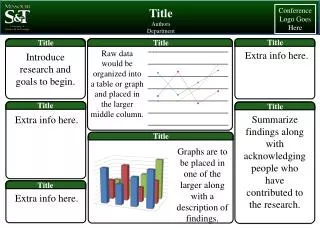
Sample Poster Format #1 http://gradcollege.okstate.edu/events/ressymp/poster_tips/postertips.html
Poster Design • Nothing handdrawn or handwritten • Powerpoint is typical • Font Type/Size • Uncomplicated Font Type • Arial, Times New Roman, etc. • Serif fonts easier to process • Sans serif fonts look neater in figures • Be consistent with font use • High contrast between text and background • Font Size • Should be readable from several feet away • Title: At least 1 inch high • Text: No less than 24 point font (18 pt for captions)
Poster Design • Panels of information • Abstract • Short summary of problem and results in poster • Introduction • Overall significance of problem addressed • Part of overall problem addressed by poster • Brief description of previous work • Goals of work addressed by poster • Experimental work • Brief description • Can use flowchart for protocols
Poster Design • Panels of information • Results • Preferably as figures in panels • Separate panels as captions • Pay attention to font type/size • White space! • Experimental work • Brief description • Can use flowchart for protocols • Conclusion • Bulleted points • Acknowledgements & References
Poster Design • Use Color • Attract Attention • Highlight flow of information • Make graphics readable • Contrasting colors • Similar color schemes hard to follow • Refrain from decorative uses of color • Colored background/foreground: Ink!!! • Play with black on white • Sparing use of color if cost issue
Sample Poster Format #2 http://gradcollege.okstate.edu/events/ressymp/poster_tips/postertips.html
CPME Poster Layout • Start with blank slide in Powerpoint • No more than 40” high (printer limitation) • Landscape orientation typical • Southern Oregon Arts and Research Format • http://www.sou.edu/soar/presentationtypes.html • Title panel across top • University logo (jpg format) • http://news.sou.edu/freshstart/download • Arrange smaller panels on blank slide • Order of information flow • Maintain some white space • Consult with mentor (layout and printing)
Sources • Davis, H.B.; Tyson, J.F.; Pechenik, J.A. Giving Oral and Poster Presentations. A Short Guide to Writing About Chemistry; Longman: Boston, MA, 2010; pp 216 – 223. • Valiela, I. Doing Science: Design, Analysis, and Communication of Scientific Research; Oxford University Press: New York, 2001; pp 154 - 158.