Download
1 / 7
70 likes | 171 Vues
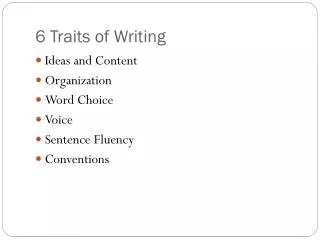
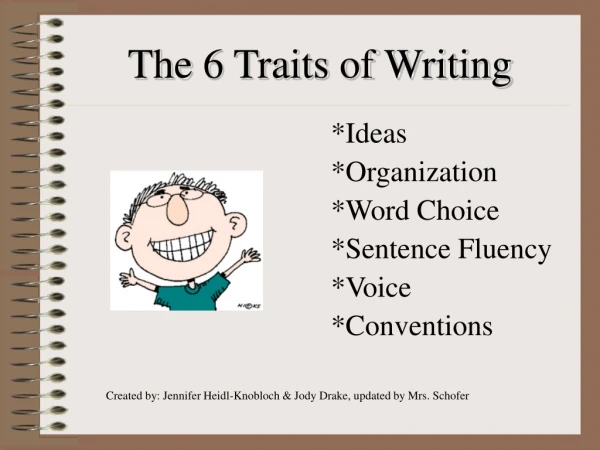
Discover the essential components of effective writing with the 6 Traits of Writing framework. This guide focuses on Ideas, Organization, Voice, Sentence Fluency, Word Choice, and Conventions. Each trait is explored with thought-provoking questions to enhance your writing. Learn how to generate clear ideas, structure your paper coherently, infuse your unique voice, achieve rhythm and fluency, choose impactful words, and apply correct conventions for clarity. Elevate your writing skills and captivate your readers.

E N D
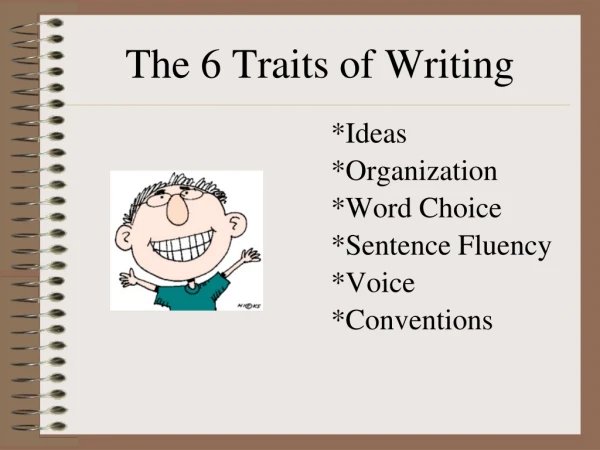
The 6 Traits of Writing Definitions and suggestions from: www.edina.k12.mn.us/concord/teacherlinks/sixtraits/sixtraits.html
Ideas • As you begin your paper you generate ideas. Your ideas and content are the reasons for writing a paper. Every paper should convey a message and be easy to follow. Some thoughts to get you going: • What is my message and is it focused and clear? • Did I include important details relevant to my topic? • Did the reader learn something new? • Is my paper interesting and easy to understand?
Organization • Organizing your ideas helps a reader move through your paper in a meaningful way. Here are some things to keep in mind as you write your paper: • Does my beginning hook my reader? • Is my paper easy to follow? • Did I choose the best way to organize my story? • Do my ideas link to a main message? • Do I have a strong conclusion that wraps up the story?
Voice • Your voice is what gives your writing personality, flavor and style. Questions to think about as you write your paper: • Can you tell I am enthusiastic about my topic? • Does this writing sound like me? • How do I want my readers to feel? • Will my story hold readers' attention? • Will they want to hear more?
Sentence Fluency • Fluent writing has rhythm. Sentences vary in length and structure. It is easy and pleasurable to read aloud. It is important to think about: • Is my story easy to read? • Do my sentences begin in different ways? • Did I use some long and some short sentences? • Does my paper sound smooth as I read it aloud?
Word Choice • The specific words that you choose create images, capture a reader's attention and make your story memorable. Look at your paper and decide: • Have I used some strong verbs or colorful phrases that grab my reader? • Have I chosen the most precise word? • Have I used any unique words? • Did I repeat common words too many times?
Conventions • You've finished your first draft. Now it is time to start editing for conventions. These include spelling, punctuation, grammar, capitalization and paragraphing. Proper use of conventions make your story easy for others to read. To begin editing ask yourself: • Did I leave spaces between words and sentences? • Did I use a title? • Did I use correct punctuation? • Did I use capital letters in the right places? • Have I proofread for correct spelling and grammar? • Have I indented any new paragraphs?