Knowledge-Based Spatio-Functional Optimization of Urban Environments in Banská Bystrica
220 likes | 337 Vues
This study focuses on applying multi-criteria decision-making techniques to optimize urban intensification processes within Banská Bystrica, Slovakia. The research aims to develop a comprehensive database for urban spatial reserves and assess their potential for intensification. Our workflow includes data gathering, expert judgment analysis, and classification of urban unused areas based on various criteria, such as accessibility and environmental factors. The findings highlight key patterns in spatial development and offer insights for municipal planning.


Knowledge-Based Spatio-Functional Optimization of Urban Environments in Banská Bystrica
E N D
Presentation Transcript
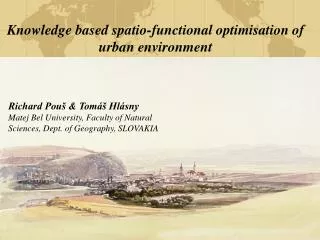
Knowledge based spatio-functional optimisation of urban environment Richard Pouš & Tomáš HlásnyMatej Bel University, Faculty of Natural Sciences, Dept. of Geography, SLOVAKIA
The purposes • To adapt the multi-criteria decision making techniques to optimise the intensification processes in a city built up area • To demonstrate these ideas in the Banská Bystrica city case study • To develop the database of the city spatial reserves • To judge the city spatial reserves intensification potential • To classify city spatial reserves into the appropriate suitability categories
The properties of knowledge-based optimisation of urban environment • Multiciteria nature • Operationality • Objectification • Retrogressive controlling
The workflow • Data gathering and processing • Decision frame definition • Evaluating space potential • Expert judgements analysis and synthesis • Synthesising • Classification • Backward tuning of decision scheme • Interpretation
Case Study – Banska Bystrica city (Central Slovakia) • Position • History • Functions
Area of interest • Banska Bystrica city built up area delimited by plot borders
Urbanely Unused Areas – The Main Potential of Morphological Intensification • The definition: All the areas laying in a city built up area the functions of which differ from those defined as “city functions” (i.e. living, working, recreation, traffic)
Materials and methods Data • Field mapping • Extracting data from municipal database • Cadastre maps Database • GeoMedia Professional, v.5.2 • Spatial component (plots, rivers, roads, administrative borders, etc.) • Attribute component (unused areas geometric and thematic features, e.g. size, slope, distance from the city center, position in biocorridor, etc.)
The criteria used • Kind of urbanely unused area • Position towards central city zone • Distance from the city functional centre • Distance from the city built up area edges • Size • Compactness • Slope • Slope aspect • Position towards climate inversions • Accessibility • Further criteria considered • Ownership • Engineering networks • Prices of plots • Functional surrounding of the area • etc.
Next plans • Include further information to evaluate intensification potential more effectively. • How intensification potential develops horizontally? Are there some global trends or gradients ? • How to implement the results of our research into municipal databases?
Conclusion • The methodology is sensitive mainly to criteria and adjudicators selection and chosen synthesizing scheme. • The case study proved • The highest weights were reached by the criteria related to position towards important city components • The second place took the morphological properties • The third place took the environmental criteria related to the natural and hygienic parameters of the plots
Morphological Intensification of Spatial Development in Postsocialist Cities - Banská Bystrica (Central Slovakia) Case Study Thank you for your attention Richard Pouš & Tomáš HlásnyMatej Bel University, Faculty of Natural Sciences, Dept. of Geography, SLOVAKIA