Overview of Legacy Satellite Communication Systems and Transponder Architectures
40 likes | 165 Vues
Explore the key features and functionalities of legacy satellite communication systems such as COMSTAR, TELSTAR, WESTAR, and GALAXY. Delve into FDMA analog transponder architecture, highlighting the principles of SSB/FDM and FDM/FM used in NASA's Advanced Communications Technology Satellite (ACTS), deployed in 1992. Discover the intricate details of multibeam antennas, fixed and spot beam setups, baseband processing, and the significance of different bandwidths for transponder usage, including FDMA, TDMA, and CDMA methodologies for optimized satellite communications and connectivity.


Overview of Legacy Satellite Communication Systems and Transponder Architectures
E N D
Presentation Transcript
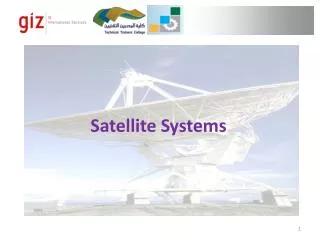
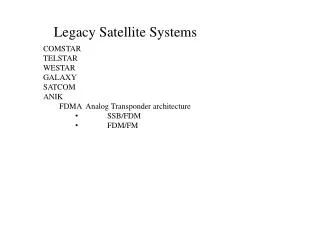
Legacy Satellite Systems • COMSTAR • TELSTAR • WESTAR • GALAXY • SATCOMANIK • FDMA Analog Transponder architecture • SSB/FDM • FDM/FM
NASA ACTS • (Advanced Communications Technology Satellite) • Deployed 1992 • 3 Fixed beam Antennas (East and West coasts) • 2 Spot beam antennas (Topeka, Cheyenne Wells) • Baseband processing (Spot Beams) • Straight up-conversion (2 Fixed Beams - one fixed Beam switchable) • CONUS coverage • Multibeam Antennas • Rx – 2.2 m @ 30 Ghz • Tx – 3.3 m @ 20 Ghz • 110 M-Baud (w/o FEC) • 55 M-Baud (64 bit frame, Rate ½, length 5 Convolutional FEC)
Geosynchronous Sats • Typical C band parameters • 500 Mhz total BW • 12 Transponders using 36 Mhz /4 Mhzguardbands • Additional 12 transponders using polarization diversity/20 Mhz offsets • Transponder Usage • FDMA: Part of transponder bandwidth is leased by customer for continuous use. • Analog/Digital • TDMA: Entire bandwidth of transponder is leased for allocated time slots • Usually digital only • Timing is critical due to range from different ground stations • CDMA: . . . . • 22,300 mi altitude • 2 degree spacing • C band 6/4 Ghz • Ku band 14/12 Ghz
CDMA(Code division Multiple Access) Spread Spectrum Data @ fPR + + NRZ Data @ fI Recovered NRZ Data @ fI IF A and B are identical and synchronized Pseudo Random Sequence Generator A @fPR >> fI Pseudo Random Sequence Generator B @fPR >> fI