Download
1 / 15
150 likes | 262 Vues
This study explores the dynamic landscape features of Indiana Dunes, focusing on dune formations and blowouts dated from hundreds to thousands of years. It examines the genetic diversity of switchgrass and other grassland species, highlighting their ecotypes characterized by variability in size, shape, and habitat preferences. Utilizing advanced genomic analysis of chloroplast and nuclear genomes, we analyze the effects of genetic and species diversity on ecosystem services. Field experiments conducted at Fermilab assess the relationship between diversity and biomass yield, revealing significant findings on ecotypic adaptations.

E N D
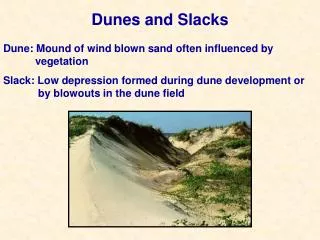
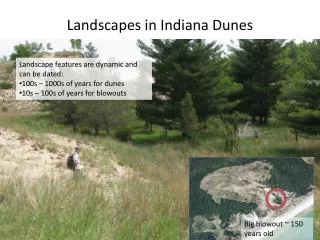
Landscapes in Indiana Dunes • Landscape features are dynamic and can be dated: • 100s – 1000s of years for dunes • 10s – 100s of years for blowouts Big blowout ~ 150 years old
Chloroplast coverage and polymorphisms Chloroplast Genome Coverage Position (kb)
Chloroplast phylogeny • Neighbor joining tree based on 140kb • Named haplogroups have >50% bootstrap • Unfilled lines indicate low-coverage sample
Nuclear genome: Multidimensional scaling ~11000 nuclear loci, mean of 100 random allele samples
Nuclear loci: Structure analysis Bayesian clustering algorithm ~11000 nuclear loci, random allele sample, Burn-in 10K, Run 10K
Ecotypic diversity in switchgrass • Switchgrass and other wide-ranging grassland species have many ecotypes • Great variability in size, shape, color, and habitat preference • Example: Upland/lowland divergence Lowland (Oklahoma) Upland (Michigan) Adapted to: Shorter growing season, Drier climates Adapted to: Long growing season, Wet climates
Reconstructed grassland experiments at Fermilab (2008-2010) • Two experiments on diversity vs. ecosystem service relationships: • Field trial: • Genetic diversity • Species diversity • Functional diversity • +/- nitrogen input • Plot experiment: • Genetic diversity (++) • Species diversity
Field trial: Experimental design 42 x 720m2 plots on a 10 acre site: - Diversity + 7 Plant treatments X N fertilization (+/-)
Biomass yield (Fall 2010-3rd year) N-Fertilized Control N fertilization: 60 lbs/acres of urea
1-BB 1-SG Mix _ 1-BB+1 -SG 2-BB 2-SG Genetic diversity 2-BB+ 2-SG 4-BB 4-SG 6-BB 3-BB+ 3-SG 6-SG + Ecotype diversity experiment 1) 14 grass varieties 2) 4 levels of diversity