Implementation of Jacobian for Manipulator Control
Learn how to use Jacobian to track velocity and orientation, determine joint angles, and more for manipulator control in robotics. Understand the considerations and conclusions of implementing Jacobian.

Implementation of Jacobian for Manipulator Control
E N D
Presentation Transcript
Ryan Keedy 5 / 23 / 2012 Jacobian Implementation
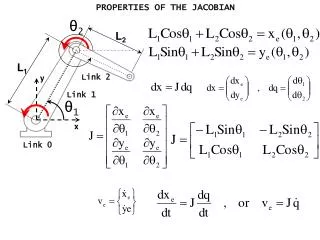
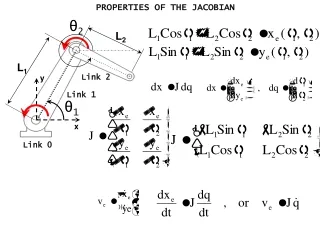
From Spong • Jacobian is the matrix that transforms degrees of freedom rates of change into end effecter rates of change • Tracks velocity AND orientation • Always 6 rows big, DOF columns wide • Upper 3 rows keep track of translation, lower three rows take care of orientation
From Spong • Lower 3 rows: • In a rotation only, 2-D situation like ours, columns are simply each DOF’s local rotation matrix dotted with (0,0,1) • Upper 3 rows: • Take the previous vectors and cross them with a vector running along the entirely of each joint length
Determining Joint Angles • The non-square matrix can obviously not be inverted to find the joint angle velocities • Multiplying by the transpose yields a singular, non-invertible matrix • Turn to damped least squared paper: • Solve for J* = (JTW1J + W2)-1 JTW1 • Angular velocities are simply J* times x’
Considerations • Because of the W matrices, result is not exactly what you want • I’ve applied it incrementally, recalculating the desired translational velocity after each movement • W2 can be manipulated to alter the overall behavior/strategy of the arm
Conclusions • Not as precise as the inverse kinematics solution • Not sure how to integrate into planning • Based on W matrices, arm has a “mind of its own” • Solutions are “unique”