Download
1 / 7
202 likes | 1.1k Vues
Learn about the primary colors of light, color addition (light), pigments and color subtraction, primary pigments, mixing pigments, complementary colors for light and pigment, as well as the concepts of black and white in the realm of light and color.

E N D
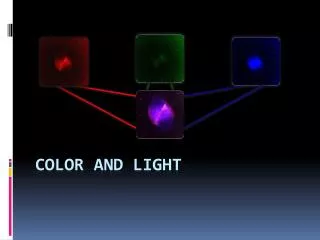
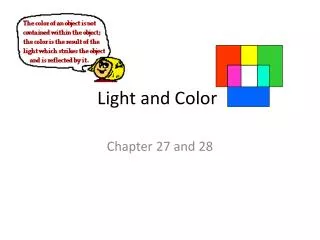
Light and Color • There are 3 primary colors of light RED, GREEN, & BLUE • When these colors of light are mixed… WhiteLight is produced • This process is called color addition
Color Addition (Light) • Red + Green = Yellow • Red + Blue = Magenta • Blue + Green = Cyan • Red + Green + Blue = White • Yellow, Magenta, and Cyan are called the secondary colors of light because they are produced using 2 of the primary colors.
Pigments • Pigments work on the principle of color subtraction. • The light we see is reflected light. • A pigment of a certain color will reflect only that color of light and absorb all other frequencies. • Example: A blue shirt will reflect incident blue light and absorb red and green.
Primary Pigments The primary pigment colors are magenta, cyan, and yellow because they absorb only one frequency of color. Yellow absorbs blue and reflects redand green. Cyan absorbs red and reflects blue and green. Magenta absorbsgreen and reflects red and blue.
Color Subtraction (Pigments) Mixing pigments means that you will see only the color that both colors reflect. Red, Blue and Greenare secondary pigments because they absorb 2 colors. Magenta + Yellow = Red Cyan + Magenta = Blue Yellow + Cyan = Green
Complementary Colors • Yellow & Blue • Cyan & Red • Magenta & Green Complementary colors are the same for light & pigment. For light, complementary colors combine to make white. For pigment, complementary colors combine to makeblack.
Black and White White light is the mixture of all frequencies (colors) of light. A white surface will reflect all frequencies (colors) of light. Black is not a color! Black is the absence of any light. A black surface will absorb all incident light and reflect none.