The Rise and Fall of Totalitarianism: America in WWII
This section explores the key dictatorships of WWII, including Mussolini's Fascism, Hitler's Nazism, and Stalin's Communism, and the global impact of totalitarian regimes following WWI. It details America's initial isolationism, the shift towards involvement in the war, and significant events like the attack on Pearl Harbor and the Battle of Britain. The aftermath of war is also covered, including the development of the atomic bomb, the establishment of Allied strategies, and the harrowing realities of the Holocaust, showcasing the era's profound challenges and legacies.

The Rise and Fall of Totalitarianism: America in WWII
E N D
Presentation Transcript
WWIIChapter 19-20 Section 1: Dictators Section 2: Isolation to Involvement Section 3: America Enters War & home Section 4: Victory & Aftermath
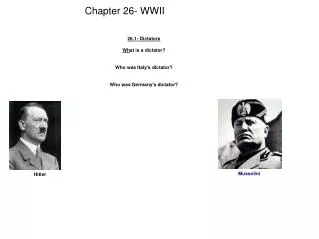
Section 1: Dictators Legacy of WWI A. Germany & Russia 1. Bitterness & Revenge B. Totalitarianism II. Dictators A. Italy 1. Benito Mussolini 2. Fascism B. Soviet Union 1. Joseph Stalin 2. Communism C. Germany 1. Hitler “Mein Kampf” 2. Nazism 3. Anti-Semitic D. Japan 1. Hirohito 2. Militarists
III. Appeasement A. Sudetenland `. Munich Pact IV. Axis Powers V. Allies A. Germany, Italy, Japan
Section 2: Isolationism to Involvement • Roosevelt’s Position • Quarantine Speech • Internationalism • War Begins 1939 • Non-Aggression Pact • Poland • Blitzkrieg • France • 1. Maginot Line • D. Britain • 1. Winston Churchill • 2. Battle of Britain, 1940 • III. America’s Involvement • A. Neutrality Act of 1935, 1937 • 1. Neutrality Act of 1939 • B. Roosevelt’s Re-election • 1. Four Freedoms • 2. Lend-Lease Act • 3. Atlantic Charter
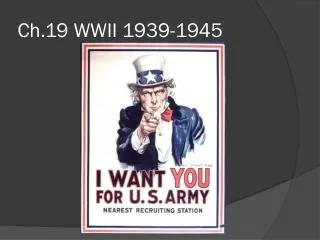
Section 3: America Enters War & at Home Pearl Harbor, Hawaii A. Roosevelt Declares War II. Mobilizing for War A. Industry 1. Liberty Ship 2. War Production Board B. Army 1. Segregation 2. Women’s Army Corps III. First American Battles (Pacific) A. Douglas MacArthur & Phillipines 1. Bataan Death March B. Doolittle Raid C. Battle of Coral Sea IV. Tides Turn A. Stalingrad 1942 B. Bombers in Germany 1. Tuskegee Airmen C. Battle of Midway
V. Women • Rosie the Riveter • VI.African Americans & Minorities • Great Migration • Zoot Suit Riots • Japanese-American Internment • Korematsuv. U.S. • VII. Rationing, Victory Gardens, Scrap Drives
Section 4: Victory & Aftermath • Casablanca Conference • Island Hopping • 1. Kamikazes • II. Tehran Conference • A. Roosevelt, Churchill, Stalin • 1. Promises • III. Operation Overlord- (D DAY) June 6th, 1944 • A. Normandy • IV. Battle of the Bulge • V. V-E Day (May 8th, 1945) • VI. Truman • A. Firebombing, Napalm • B. Manhattan Project • 1. Completely unknown • 2. Atomic Bomb • - Aug 6th, 1945; Hiroshima • -Aug 9th, 1945; Nagasaki • C. V-J Day (Aug 15th, 1945)
VII. The Holocaust A. Nazi Ideology 1. Nuremberg Laws B. Night of Broken Glass (Kristallnacht) C. Final Solution 1. Concentration & Extermination Camps 2. Auschwitz 1,600,000 Died