Download
1 / 5
50 likes | 174 Vues
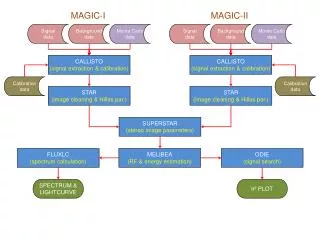
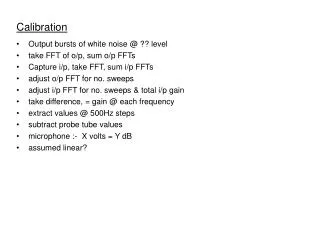
This document discusses the calibration process for Callisto logarithmic detectors using a specific equation that requires three independent measurements. It outlines the sources of noise, the setup parameters, and the necessary variables involved in the calibration process. The final calibration equation is derived by simplifying a complex set of non-linear equations, allowing for numeric solutions rather than mathematical. Additional considerations include the impact of second-order effects such as side lobes and cable loss. Ultimately, the aim is to enhance the calibration accuracy by comparing cold sky measurements to those of the sun.

E N D
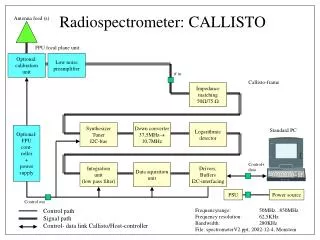
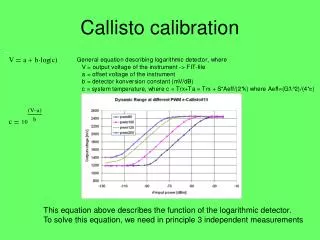
Callisto calibration This equation above describes the function of the logarithmic detector. To solve this equation, we need in principle 3 independent measurements
Callisto calibration Noise source +35dB enr FIT Calibration IDL, C++ Noise source +25dB enr Callisto spectrometer 50Ω termination = ~300K
Callisto calibration Known: Vcold, Vwarm, Vhot, Tcold, Twarm and Thot Unknown: Vo, b and Trx This set of non-linear equations can not be solved mathematically correct, it can only be solved numerically But since Trx ~ Tcold << Twarm < Thot, the set of equations can be simplified. This simplification leads to a set which can be solved straight forward.
Callisto calibration Final equation for calibration: • Still without taking into consideration second order effects like: • Side lobes • Spill over • Cable loss (antenna – switch) • Noise temperature enhancement by physical temperature of cables (antenna – switch) • To improve, do the same on the cold sky and take the difference S = S(sun) – S(sky) k = Boltzmann constant K = 1 Kelvin λ = wavelength = c/f [m] G = antenna gain Trx = receiver noise temperature [K] V = voltage at one frequency on the sky Vo = offset voltage at the same frequency b = detector coefficient at the same frequency S = radio flux of sky/sun at the same frequency [sfu]