Mao's China: The Reality of Revolution and Its Aftermath
This exploration of Mao's China delves into the harsh truths of revolution as articulated by Mao himself, emphasizing that a revolution is an act of violence intended to overthrow an existing class structure. The focus then shifts to significant geographical changes as the Communist Party gained control of regions like Xinjiang, Inner Mongolia, Manchuria, and Tibet. Initially benefiting from Soviet support, China eventually distanced itself ideologically, yet not without enhancing literacy and public health. However, this progress was shadowed by violent repression of dissent within the Communist regime.

Mao's China: The Reality of Revolution and Its Aftermath
E N D
Presentation Transcript
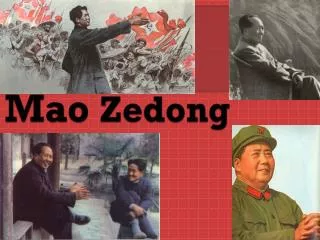
Mao’s China: “A revolution is not a dinner party...”
“A revolution is not a dinner party, or writing an essay, or painting a picture, or doing embroidery; it cannot be so refined, so leisurely and gentle, so temperate, kind, courteous, restrained and magnanimous. A revolution is an insurrection, an act of violence by which one class overthrows another.”
Geographical Changes • Communist China gained control over: • Chinese • Turkestan (Xinjiang) • Inner Mongolia • Manchuria • Tibet PRC = People’s Republic of China (Communists) / ROC = Republic of China (Nationalists)
China Modeled on Soviet Union • Soviet Union provided financial support, aid in China’s first years • China modeled many of its new political, economic, military policies on Soviet system • 1950s, territorial disputes, differences in ideology pushed China away from Soviet ally Improvements in literacy rates, public health • Chinese life expectancy increased sharply over next few decades • Improvements came at a cost • To consolidate Communist control over China, government soon began to eliminate so-called “enemies of the state” who had spoken out against government’s policies • Many thousands—including public officials, business leaders, artists, writers—killed, or sent to labor camps
All health care was free • Western and traditional healthcare were practiced.