Understanding Type Inference and Unification in Typed Languages
This document explores the concepts of type inference and unification in a toy typed language. It outlines how type declarations are optional, using examples like the factorial function (`letrec fact(n)`). The text delves into how types can be inferred through the evaluation of expressions, illustrating the unification process for type variables. It highlights the methodologies for checking type equality and provides insight into the necessary structures and algorithms for unification. Ultimately, it presents a systematic approach to managing types in a programming context.

Understanding Type Inference and Unification in Typed Languages
E N D
Presentation Transcript
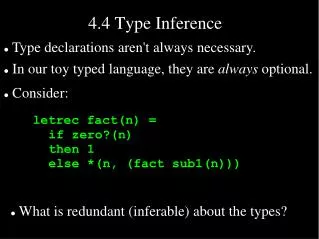
4.4 Type Inference • Type declarations aren't always necessary. • In our toy typed language, they are always optional. • Consider: letrec fact(n) = if zero?(n) then 1 else *(n, (fact sub1(n))) • What is redundant (inferable) about the types?
4.4 Type Inference • zero? is defined as int->bool, so n must be int • then returns 1, so fact must return int • so we have inferred all the types letrec int fact(int n) = if zero?(n) then 1 else *(n, (fact sub1(n)))
Unification • Treat programs as formulas over type variables. • Solve for variables using algebra. • This method is called unification (ML, Prolog) • Another example: proc(? f, ? x) (f +(1,x) zero?(x)) ExpressionType Variable f tf x tx (f +(1,x) zero?(x)) t1 +(1,x) t2 zero?(x) t3
Unification proc(? f, ? x) (f +(1,x) zero?(x)) f tf x tx (f +(1,x) zero?(x)) t1 +(1,x) t2 zero?(x) t3 • Type of whole expression = (tf * tx -> t1) • Solve for tf, tx, t1: ExpressionType Equation (f +(1,x) zero?(x)) tf = (t2*t3->t1) +(1,x) (int*int->int) = (int*tx->t2) zero?(x) (int->bool) = (tx->t3)
Unification ExpressionType Equation (f +(1,x) zero?(x)) tf = (t2*t3->t1) +(1,x) (int*int->int) = (int*tx->t2) zero?(x) (int->bool) = (tx->t3) • Therefore: tx = int t3 = bool t2 = int tf = (int * bool -> t1) t1 = ? • Body = ((int * bool -> t1)* int -> t1) • I.e., body is polymorphic int1.
Unification • So we need: (1) data structure for type variables • (2) unification algorithm • Name all variables t1, t2, t3, ... (“serial number”) • Variable has an (intially empty) container filled by • unification: (define-datatype type type? (atomic-type (name symbol?)) (proc-type (arg-types (list-of type?)) (result-type type?)) (tvar-type (serial-number integer?) (container vector?)))
Unification: check-equal-type!(t1,t2) If t1 and t2 are atomic types (bool, int), suceed if they have the same name; else fail. (Note that constants like 1 and true are implicitly typed: int and bool, respectively.) If t1 is a type var, check that its contents are the same as the contents of t2 (and vice-versa ) using check-tvar-equal-type! (see next page). If either is an (unassigned) variable, set its contents to the contents of the other: type inference! If t1 and t2 are procedure types, check # of args equal and recur on args. Otherwise, fail.
(define check-tvar-equal-type! (lambda (tvar ty exp) (if (tvar-non-empty? tvar) (check-equal-type! (tvar->contents tvar) ty exp) (begin (check-no-occurrence! tvar ty exp) (tvar-set-contents! tvar ty))))) • Need check-no-occurence! to avoid, eg., • t1 = (int ->t1).